Real - World Assets
Tokenized Asset Due Diligence: What Institutions Must Verify Before Capital Allocates
October 23, 2026
10 mins read
Standard due diligence for tokenized assets covers legal structure and custody. It does not cover the data layer: NAV sourcing, borrower state, reserve accuracy, audit trail continuity. Those gaps cannot be resolved by adding custodians or attestors. A verifiable database layer that generates cryptographic proofs is what closes them.


TL;DR: Standard due diligence for tokenized assets covers legal structure and custody. It does not cover the data layer, NAV sourcing, borrower state, reserve accuracy, audit trail continuity. Those gaps cannot be resolved by adding custodians or attestors. A verifiable database layer that generates cryptographic proofs is what closes them.
Introduction
Institutional allocators reviewing tokenized assets run the same due diligence playbook they use for traditional structured products: legal review, counterparty assessment, custody confirmation. What that playbook does not cover is the data layer that sits between the off-chain asset and the on-chain token.
They map directly onto the valuation opacity and audit-trail gaps that keep institutional capital on the sidelines. They are relayed by intermediaries, attested periodically, and trusted by convention. For institutional allocators, that gap represents a category of risk that existing frameworks do not name, let alone price.
Key Takeaways
- Tokenized asset due diligence currently covers legal structure and custody. It does not address data integrity, whether the data backing the token's value is accurate and continuously verifiable.
- IOSCO's 2025 tokenization guidance identified six risk categories across 14 jurisdictions; data integrity and audit trail continuity appear in multiple categories but are not covered by standard attestation cycles.
- Adding custodians or third-party attestors increases the number of parties to trust without providing cryptographic proof of data accuracy.
- Zero-Knowledge Proofs allow a verifier to confirm that a data condition is true without accessing the underlying records, a capability that standard due diligence cannot replicate.
- Institutional allocators should add six specific data questions to their tokenized asset review framework before capital commits.
What Makes Tokenized Asset Due Diligence Different From Traditional Allocation Review?
Tokenized assets inherit all the data verification challenges of the underlying assets and add a new one: the on-chain token is a derived representation of an off-chain record that no on-chain mechanism can independently verify.
Traditional due diligence on a bond or fund position relies on a custodian holding the instrument, a fund administrator calculating NAV, and periodic audit reports confirming record accuracy. Each of those roles involves a trusted intermediary confirming a data state at a point in time.
That model works tolerably for traditional markets where settlement cycles match review cycles. For tokenized assets designed to operate in DeFi, where collateral is deployed against NAV at machine speed, periodic attestation creates a data integrity gap between cycles. The token trades continuously; the data behind it updates on a quarterly or monthly cadence.
IOSCO's November 2025 framework analysis of tokenized assets across 14 jurisdictions identified this as a structural feature, not an edge case. Off-chain registers remain the legal authority for ownership in most jurisdictions. The on-chain record is a derived mirror, accurate when last updated, with no automatic verification that it still reflects the authoritative state.
The relevant question for institutional due diligence is not "is this token legally structured?" but "can the data backing this token be continuously verified, and by whom?"
For a technical overview of where verification gaps appear in tokenized asset stacks, see How Can zkDatabase Be Applied to Real-World Assets?.
The Six Data Conditions That Institutional Allocators Cannot Verify Through Standard Channels
Standard due diligence does not cover six data conditions that directly affect the risk profile of a tokenized asset position. These require either continuous machine-readable proof or a verifiable database layer, neither of which comes standard in current tokenization infrastructure.
1. NAV calculation lineage
The reported NAV is a number. The calculation methodology, input data sources, and update frequency that produced it are typically opaque. An allocator reviewing a tokenized fund can verify that a NAV figure was reported; they cannot verify that the calculation is consistent with the fund's stated methodology or that the input data was not stale.
2. Borrower covenant status at time of allocation
For tokenized private credit, a borrower's covenant compliance status is updated on a reporting schedule that may not align with when capital is deployed. An allocator committing capital may be acting on covenant data that is weeks old. The reported status at allocation time is not independently verifiable without access to the servicer's database.
3. Reserve coverage continuity
For tokenized money market funds and stablecoin-adjacent structures, reserve coverage ratios are typically attested monthly or quarterly. Between attestations, the reserve state is not verifiable by counterparties or allocators. An allocation decision made mid-cycle relies on the last attestation plus an assumption of continuity.
4. Cross-chain record consistency
Tokenized assets increasingly move across chains for yield or liquidity. When a token bridges, the off-chain register updates but the receiving chain cannot confirm that the record on the originating chain and the authoritative off-chain register are consistent. Due diligence conducted on one chain may not reflect the current state of a cross-chain position.
5. Investor attribution at the pool level
DeFi pools that accept tokenized assets as collateral aggregate positions across investors. Once a tokenized asset enters a pool, per-investor attribution, who owns what, at what NAV, collapses to pool-level accounting. Investor-level compliance obligations (KYC status, transfer restrictions, reporting requirements) cannot be enforced or audited at the pool level without a proof layer that preserves per-investor attribution.
This was identified as the "Securitize problem" in Four Pillars' April 2026 analysis: Vault = Investor as a design choice erases the investor-level data that compliance requires.
6. Audit trail continuity
Regulators examining tokenized asset positions need to reconstruct data state at every material point. Standard audit trails are compiled after the fact from multiple systems, each with its own access controls and retention policies. A continuous, tamper-evident audit trail requires that every data state change be logged in a system that produces verifiable historical proofs.
 Diagram: Six data conditions in tokenized asset due diligence and the verification gap each represents
How a Verifiable Database Layer Changes the Due Diligence Stack
A verifiable database layer that generates Zero-Knowledge Proofs for each data query replaces periodic attestation with continuous, machine-readable verification, without requiring allocators or counterparties to access the underlying records.
The mechanism: the authoritative off-chain database (NAV calculation system, covenant monitoring database, reserve ledger) is committed to a Merkle tree structure that zkDatabase maintains. When a query is made, "is NAV within the stated range," "is this borrower's LTV below 65%," "is this investor's KYC status current", zkDatabase generates a proof that the query result is consistent with the current state of the database.
That proof is verifiable on-chain without reading the database. An allocating protocol, a DeFi money market accepting collateral, or a compliance engine running investor-level checks can verify the proof programmatically.
For due diligence purposes, this changes three things. First, NAV and covenant status can be verified at the time of allocation, not at the last attestation cycle. Second, per-investor attribution can be preserved within a pool without exposing investor-level data to the pool's liquidity providers. Third, the audit trail is continuous and provable, any historical state can be verified without reconstructing records from multiple systems.
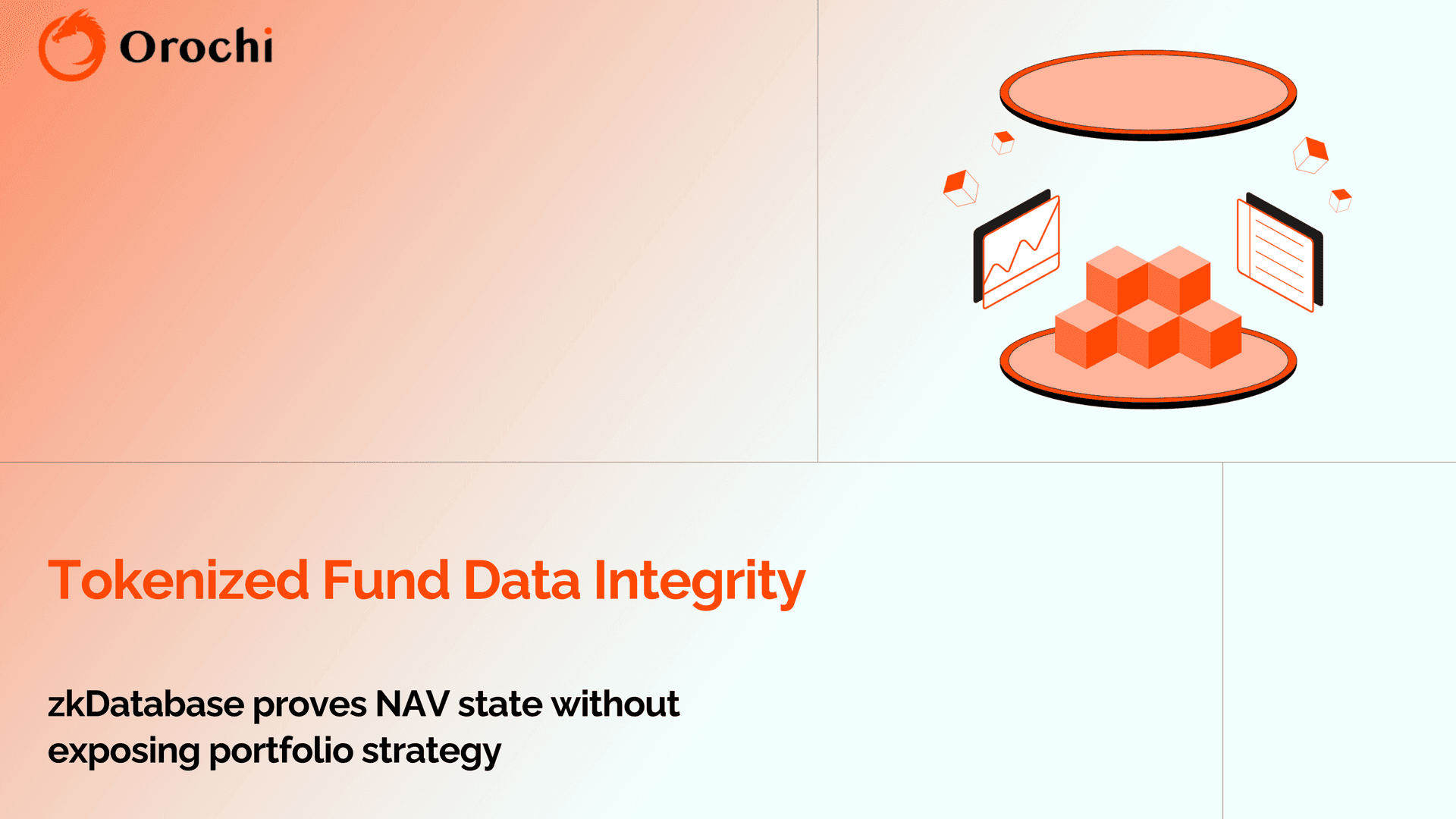
For the specific problem of NAV verification in DeFi collateral settings, see Tokenized Fund Data Integrity: The Verifiable Layer That Capital Markets Are Missing.
Why Stacking Custodians and Attestors Does Not Close the Verification Gap
Adding more custodians or third-party attestors to the due diligence stack increases the number of parties that need to be trusted, but trust is not the same as proof.
This distinction matters for institutional allocators. The standard response to data integrity risk in tokenized assets is to add intermediaries: more custodians, more frequent attestations, third-party data providers. Each addition multiplies the trust surface. An allocator now has to trust five parties accurately relaying data rather than one, a situation that adds counterparty risk without providing independent verification.
Zero-Knowledge Proofs break that logic. A proof generated by zkDatabase does not require the verifier to trust the entity generating it, the proof is mathematically verifiable against the committed database state. The verification is the assurance; no additional trusted party is required.
For allocators, this suggests a practical due diligence question: does the tokenized asset protocol prove data states cryptographically, or does it relay them through trusted intermediaries? The former can be verified independently. The latter requires trusting a chain of parties whose access controls and operational standards must be assessed separately.
The broader implication for institutional-grade asset tokenization platforms is explored in Asset Tokenization Platform: Institutional Grade Must Prove.
Conclusion
Tokenized asset due diligence, covering tokenized assets across private credit, tokenized funds, and structured products, as currently practiced does not cover the data layer. NAV sourcing, borrower covenant status, reserve continuity, audit trail integrity, these data conditions affect the risk profile of every tokenized position, and none of them are verifiable through standard custodian or attestation channels.
A verifiable database layer that generates continuous, machine-readable proofs is what closes that gap. For institutional allocators, adding six specific data questions to their review framework, and asking whether a protocol can answer those questions with proof, not attestation, changes what due diligence covers.
Work With Orochi Network
If you are evaluating tokenized asset protocols and want to understand what verifiable data infrastructure requires in practice, the Orochi Network team can walk through the technical architecture and how zkDatabase integrates with existing data pipelines.
FAQ
What is tokenized asset due diligence and why does it differ from traditional asset review?
Tokenized asset due diligence covers the same legal and custody questions as traditional structured product review, plus a set of data integrity questions that traditional review does not address. Specifically, the on-chain token is derived from an off-chain record that no on-chain mechanism can verify independently, so allocators need to assess how the data backing the token is sourced, updated, and proven. Standard custodian and attestation frameworks do not cover this.
What data conditions are hardest to verify in a tokenized asset allocation?
NAV calculation lineage, borrower covenant status at time of allocation, reserve coverage continuity between attestation cycles, cross-chain record consistency, per-investor attribution within pools, and audit trail continuity. Each of these requires either continuous machine-readable proof or direct access to the underlying data system, neither of which comes standard in current tokenization infrastructure.
How do Zero-Knowledge Proofs improve the due diligence process for institutional allocators?
Zero-Knowledge Proofs let a verifier confirm that a data condition is true without accessing the underlying records. For due diligence, this means NAV and covenant status can be verified at time of allocation (not last attestation), per-investor attribution can be confirmed without exposing sensitive data, and audit trail proofs can be verified without reconstructing records from multiple systems.
Does adding more custodians or third-party attestors solve the tokenized asset data integrity problem?
No. Additional intermediaries multiply the trust surface without providing independent verification. An allocator trusting five parties to relay data accurately still has no cryptographic confirmation that any of them are correct. Zero-Knowledge Proofs replace trust with mathematical proof: the verifier does not need to assess the intermediary's reliability because the proof is independently verifiable against the committed database state.
Related toReal - World Assets