About zkDatabase
zkDatabase: What a Provable Database Is and Why Institutions Need One
July 25, 2026
9 mins read
A provable database lets institutions verify data integrity with cryptographic evidence instead of trusting reported values.


TL;DR: A provable database stores data in a way that lets another system verify the integrity of a record, query, or state transition with cryptographic evidence. For institutions, that matters because stablecoin reserves, tokenized asset states, collateral data, and compliance conditions often need to be verified without exposing the raw data.
On-chain finance increasingly depends on off-chain asset, reserve, identity, and compliance data, and institutions cannot act on numbers they cannot verify. That is why a provable database matters to them. zkDatabase, Orochi Network's provable database, creates cryptographic evidence that a data condition is true without requiring public disclosure of the underlying dataset.
Meta Block
- Meta title: zkDatabase: What Is a Provable Database?
- Meta description: Learn what a provable database is, why institutions need one, and how zkDatabase supports verifiable data workflows without exposing raw data.
- URL slug: zkdatabase-provable-database-institutions
- SEO target: zkDatabase | provable database | Current pos: ~10
Key Takeaways
- zkDatabase is a provable database designed for institutional data integrity, not a generic storage layer.
- A provable database lets smart contracts or auditors verify claims about data without relying only on the database operator.
- Stablecoin issuers, RWA protocols, custody teams, and institutional DeFi platforms all face the same gap: off-chain facts are reported, not proven.
- Zero-Knowledge Proofs can support selective disclosure, so institutions can prove conditions without exposing sensitive balances, counterparties, or user data.
- zkDatabase can complement audit, compliance, and reporting workflows by creating cryptographic evidence between formal review cycles.
What is zkDatabase as a provable database?
zkDatabase is a provable database that generates cryptographic evidence about database state and operations. Instead of asking a verifier to trust the operator's database, zkDatabase lets the verifier check a proof tied to the relevant data state.
The distinction matters because institutional blockchain systems rarely fail at the token layer first. They fail at the data layer beneath it, the institutional data integrity gap that zkDatabase was built to close. A smart contract can execute perfectly and still act on stale NAV data, incomplete reserve data, or an eligibility record that was never independently verified.
A traditional database can store the same information. It can also enforce permissions, write logs, and export reports. What it cannot do by default is prove to an external verifier that a record existed, a query returned the correct result, or a state transition followed an approved rule.
zkDatabase adds that proof layer to the database itself. Orochi Network describes this as Verifiable Data Infrastructure: data becomes something a smart contract, auditor, or counterparty can verify, not merely something an institution publishes.
For background on the broader category, see Orochi Network's guide to Verifiable Data Infrastructure.
Why do institutions need a provable database now?
Institutions need a provable database because regulated on-chain finance depends on off-chain facts that are too sensitive to publish and too important to trust blindly. This is most visible in stablecoins, tokenized assets, custody, capital markets, and institutional DeFi.
Consider a stablecoin issuer. The public claim is simple: outstanding tokens are backed by eligible reserves. The operational proof is harder. The issuer must reconcile token supply across chains, reserve composition across custodians, redemption liquidity, reporting cutoffs, and internal approvals. A monthly report helps, but it does not prove what happened between reports.
The same pattern appears in RWA tokenization. A token may represent a fund share, Treasury exposure, loan claim, or collateral right. But the asset state usually lives in off-chain systems: transfer agents, custodians, fund administrators, loan servicers, and compliance registries. The token is on-chain. The evidence is not.
This is the gap between a database and a provable database. The first stores the institution's view of the world. The second creates cryptographic evidence that a specific claim about that world is true.
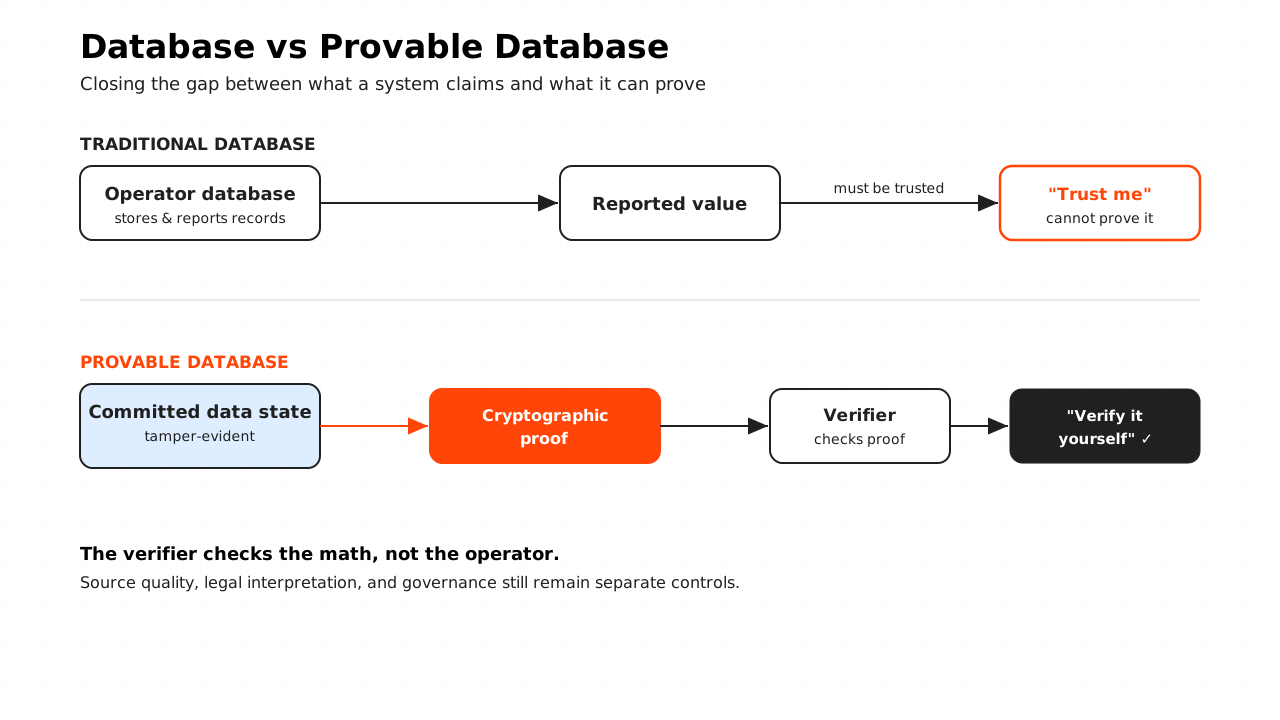 A traditional database asks a verifier to trust reported values; a provable database lets the verifier check a cryptographic proof over committed data instead.
Existing Orochi content on off-chain to on-chain data authenticity explains why this matters for smart contracts that depend on real-world data.
How does a provable database differ from an oracle, audit, or traditional database?
A provable database is not a replacement for every oracle, audit, or internal system. It addresses a different question: can a verifier check the integrity of the data operation itself?
| Approach | What it usually proves | What remains trusted |
|---|---|---|
| Traditional database | The operator can store and retrieve data | Operator controls, logs, permissions, and exports |
| Oracle network | A value was delivered to a smart contract | Source data integrity and upstream computation |
| Periodic audit or attestation | A snapshot met a review standard at a point in time | State between review dates |
| Provable database | A committed data state, query, or transition satisfied defined rules | Source quality, legal interpretation, and operational governance |
This distinction keeps the claim honest. zkDatabase does not make an issuer compliant by itself. It can complement the issuer's audit, reporting, and control environment by creating proof artifacts around data state and data operations.
The useful question for a CTO or Head of Risk is not "does this replace our database?" It is "which reported facts should become verifiable before a contract, counterparty, or regulator relies on them?"
For a related comparison around data reliability, Orochi's post on oracle manipulation is a useful internal link.
What institutional workflows can a provable database support?
A provable database can support workflows where a party needs evidence about private or off-chain data. The strongest use cases are reserve verification, asset lifecycle tracking, collateral monitoring, eligibility checks, and audit trail generation.
In stablecoins, zkDatabase can help prove that reserve-related data satisfy a defined condition, such as backing, composition, or reconciliation logic, without exposing raw custodian balances. This can support reporting and audit-readiness workflows, while formal compliance still depends on issuer controls and regulator requirements.
In RWA tokenization, a provable database can help connect ownership, NAV, collateral, and custody state to on-chain verification. The purpose is not to publish every private asset record. The purpose is to make the relevant condition verifiable.
In institutional DeFi, the same mechanism can apply to collateral state, borrower eligibility, or covenant data. A protocol may not need to know a borrower's full financials. It may need to verify that a required condition was satisfied at the time of a loan action.
This is why a provable database is useful for institutional workflows. It allows teams to separate proof from disclosure.
For RWA-specific context, see Orochi's article on the RWA data integrity problem.
How does zkDatabase fit into institutional data architecture?
zkDatabase fits between private data systems and verifiers that need cryptographic evidence. Data remains off-chain, while proofs or commitments can be verified by supported on-chain contracts or other verification workflows.
At a high level, the architecture has four parts:
- Data is sampled or ingested from a source system.
- The data is structured into a provable format.
- Queries or transformations generate proofs over committed data.
- A verifier checks the proof instead of trusting the database operator.
This is especially useful when the verifier should not see the raw data. A stablecoin reserve proof may need to show that a threshold is met. A compliance-state proof may need to show that a wallet belongs to an approved set. A tokenized fund proof may need to show that a NAV computation followed an approved method.
In each case, the institutional value is not "more transparency" in the generic sense. It is controlled transparency: enough evidence to verify the claim, without unnecessary exposure of confidential data.
For the technical sequence behind this model, see the companion article on how zkDatabase works from data sampling to verifiable query results.
What should institutions take away from a provable database?
Conclusion: zkDatabase gives institutions a provable database model for the data layer that sits beneath stablecoins, RWA, custody, and institutional DeFi. The institutional problem is not simply storing more data. It is proving which off-chain facts a smart contract, auditor, or counterparty can rely on.
Orochi Network's role is to provide Verifiable Data Infrastructure that can help turn database state into cryptographic evidence. That evidence can support audit, compliance, and reporting workflows without claiming to replace the legal, operational, or governance controls those workflows still require.
Explore zkDatabase
See how zkDatabase turns institutional data claims into verifiable proof workflows.
See how zkDatabase turns institutional data claims into verifiable proof workflows.
FAQ: What should institutions ask next?
What is zkDatabase?
zkDatabase is Orochi Network's provable database for generating cryptographic evidence about off-chain data states and operations. It is designed for workflows where a verifier needs to check that data is correct, untampered, or rule-compliant without seeing every underlying record. This makes it relevant for stablecoin reserves, RWA asset state, custody data, and institutional DeFi data.
What is a provable database?
A provable database is a database that can produce cryptographic proofs about stored data, query results, or state transitions. The verifier does not have to trust only the database operator's report. Instead, the verifier can check whether a committed data state or operation satisfies a defined rule.
Does zkDatabase guarantee compliance?
zkDatabase does not guarantee compliance or replace legal review, audits, or regulated reporting obligations. It can help support compliance-adjacent workflows by providing cryptographic evidence about data states and conditions. Whether that evidence satisfies a specific requirement depends on the jurisdiction, regulator, issuer controls, and audit framework.
How is zkDatabase different from an oracle?
zkDatabase and oracle systems address different parts of the data stack. An oracle typically delivers a value to a smart contract, while zkDatabase can help prove properties about the database state, query, or transformation that produced a value. In practice, the two can be complementary when institutional workflows need both delivery and verifiability.
Related toAbout zkDatabase