Research
Data Privacy Compliance for Institutions: Selective Disclosure, Not Secrecy
July 14, 2026
8 mins read
Institutions don't want to hide their data on-chain. They want to disclose the right fact to the right party and prove the rest. That is selective disclosure, and it reframes what data privacy compliance means.


TL;DR: Institutions don't want secrecy on-chain; they want selective disclosure: the ability to hide a position from competitors while letting an auditor or regulator verify the underlying state. Compliance for institutions is therefore not about encryption alone, but about proving the right condition to the right party without exposing the full dataset.
When an institution says it cannot put its book on a public ledger, the reason gets labeled "privacy." That label is misleading. A fund with fiduciary obligations is not trying to make its data disappear; it is trying to keep sensitive positions away from competitors while still satisfying auditors, regulators, and counterparties who need to trust the numbers. Those two requirements pull in opposite directions, and a system that only offers "public" or "hidden" forces a choice between them. The model institutions actually want is selective disclosure: reveal exactly what a given party is entitled to, and prove the rest without showing it.
What does data privacy compliance actually require on-chain?
On-chain, this requires selective disclosure, not blanket secrecy. An institution needs to keep sensitive data away from the open market while still letting an auditor, regulator, or counterparty verify the underlying state on demand.
A public ledger exposes everything by default. A fully private system exposes nothing and asks everyone to trust a report. Neither satisfies an institution, because compliance is not the absence of disclosure. It is disclosure controlled by entitlement. The auditor sees what the auditor is owed. The regulator can check what the rule requires. The competitor sees nothing actionable. Each party gets a different view of the same underlying truth.
This is why "encrypt the data" is only half an answer. Encryption hides the value, but compliance also requires someone to confirm the hidden value is correct. The requirement is two-sided: keep the record private, and still make the relevant fact provable.
Privacy is the wrong word for the institutional problem
Calling the institutional requirement "privacy" frames it as hiding, when the real requirement is controlled verification. Institutions are not optimizing for secrecy; they are optimizing for who can prove what.
Retail users want privacy in the ordinary sense: keep my balance to myself. An institution's need is structural. A tokenized fund cannot broadcast client positions, but it also cannot operate on "trust our quarterly PDF" when allocators are underwriting it. The word "privacy" collapses these into a single hiding problem and hides the harder half: the verification the institution still owes.
This reframing matters because it changes the product target. If the goal is secrecy, you build an opaque system. If the goal is controlled verification, you build a system where facts can be proven to authorized parties without the raw data leaving the institution. We made the broader version of this argument in why institutions have a privacy problem, not a blockchain problem.
Full transparency and full secrecy both fail institutions
Public-by-default and private-by-default are both dead ends for institutional adoption. Full transparency leaks strategy and client data; full secrecy reinstates the trust-based reporting that tokenization was supposed to remove.
These are two legitimate requirements in direct conflict. An institution must protect sensitive positions, and it must prove its claims to parties who will not take its word. A transparent ledger satisfies the second and violates the first. A walled-off private system satisfies the first and violates the second, because if the only thing shared is a report, the on-chain asset inherits the old "trust me" model.
| Model | Competitor sees position | Auditor can verify state | Fits fiduciary duty |
|---|---|---|---|
| Full transparency | Yes | Yes | No — leaks client data |
| Full secrecy | No | No — only a report | No — reinstates trust-based reporting |
| Selective disclosure | No | Yes — proof, not raw data | Yes |
Selective disclosure is the only column that satisfies both obligations. It is not a compromise between them; it is a different mechanism that serves each one separately.
Selective disclosure means: hide from competitors, prove to auditors
Selective disclosure lets an institution keep a position confidential from the market while generating proof that an auditor or regulator can check directly. The same data state produces a different, entitlement-bound view for each party.
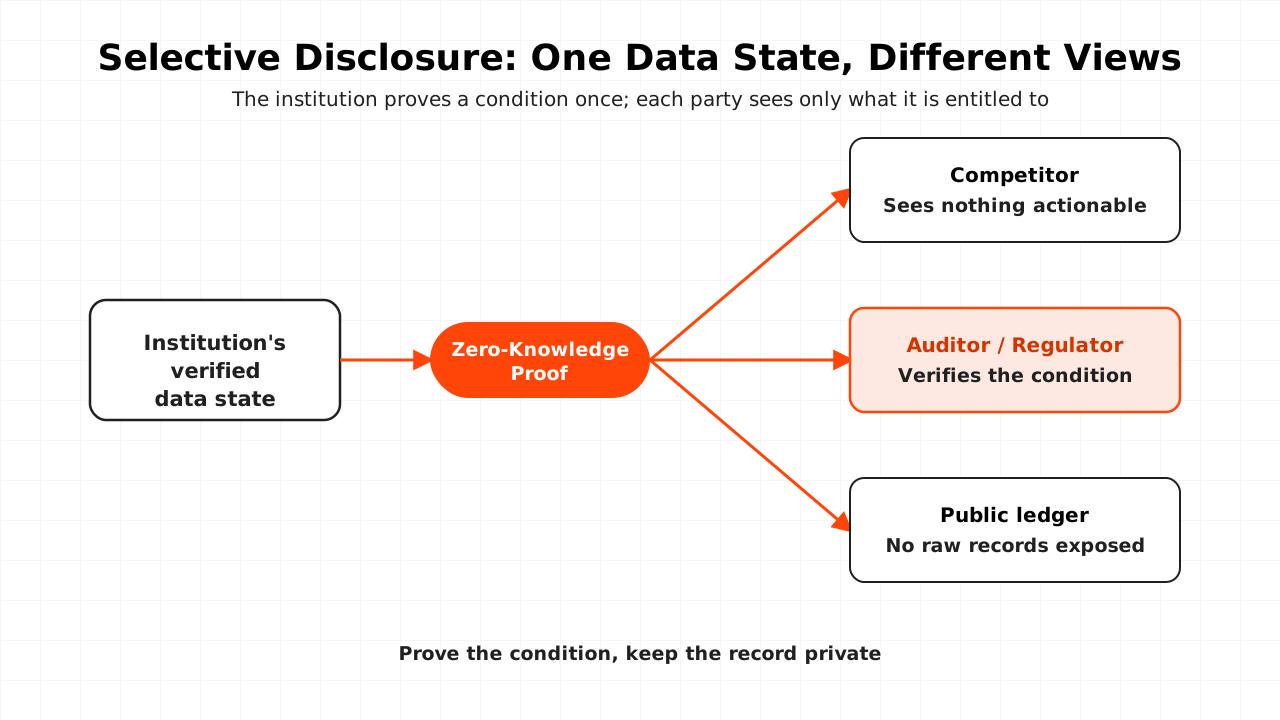 One verified data state, proven once, produces a different entitled view for each party: the competitor sees nothing actionable, the auditor verifies the condition, and no raw records are exposed.
Privacy should not mean hiding everything. It should mean proving the relevant condition without exposing the full record behind it. A reserve attestation can prove backing is sufficient without publishing the holdings. A fund can prove its Net Asset Value was computed correctly without revealing every position. A lender can prove a borrower met a covenant without exposing the borrower's books.
In each case the institution discloses a verified conclusion, not the underlying data. That is the operational meaning of "prove the condition, keep the record private," and it maps directly onto how regulators are framing tokenized-fund and reserve oversight: continuous, checkable verification rather than periodic reports. Regulatory programs around tokenization, including MAS Project Guardian and recent fund-tokenization guidance, point in the same direction.
How proof enables disclosure without exposure
Zero-Knowledge Proofs make selective disclosure possible: they prove a statement about hidden data is true without revealing the data. This is what lets an institution satisfy a verifier while keeping the record private.
A Zero-Knowledge Proof confirms a condition (reserves exceed liabilities, a position is within mandate, a borrower cleared a threshold) without disclosing the inputs that establish it. The verifier checks the proof, not the data. Privacy-preserving computation extends the same idea to operations on encrypted values, so a result can be produced without the operator ever seeing the raw inputs in the clear.
The practical effect is that disclosure stops being all-or-nothing. Instead of choosing between publishing the data and hiding it, the institution publishes a proof. We walk through this for reserves in privacy-preserving proof of reserves and for identity checks in AML/KYC without mass surveillance.
What this means for compliance workflows
Selective disclosure turns compliance from periodic reporting into continuous, verifiable proof. The institution proves each relevant condition at the source, and authorized parties verify it on demand without the raw records changing hands.
For a stablecoin issuer, that means proving reserve adequacy continuously instead of publishing a monthly attestation. For an RWA protocol, it means proving asset state and ownership without exposing investor-level detail. For an on-chain credit desk, it means proving covenant compliance without revealing the borrower's full position. The disclosure is scoped to what each party is entitled to see.
zkDatabase operates at this layer. It generates proof over the data pipeline so an institution can prove a condition to a verifier without exposing the underlying records. It does not replace the auditor; it gives the auditor a record they can verify without trusting the operator. For the compliance-specific treatment, see Zero-Knowledge Proof compliance for financial institutions and data privacy compliance for tokenized assets.
Key Takeaways
- Institutional data privacy compliance is about selective disclosure, not secrecy: reveal the right fact to the right party, prove the rest.
- "Privacy" mislabels the problem. The real requirement is controlled verification: who can prove what.
- Full transparency and full secrecy both fail institutions; only selective disclosure satisfies both confidentiality and verification.
- Zero-Knowledge Proofs and privacy-preserving computation make disclosure scoped rather than all-or-nothing.
- The shift turns compliance from periodic reporting into continuous, verifiable proof at the source.
FAQ
What is data privacy compliance for institutions on-chain?
For institutions, it is the ability to keep sensitive data confidential from the open market while still proving the relevant facts to auditors, regulators, and counterparties. It depends on selective disclosure rather than blanket encryption.
How is selective disclosure different from privacy?
Privacy, in the ordinary sense, means hiding data. Selective disclosure means controlling who can verify which fact. An institution hides its position from competitors while proving the underlying state to an authorized verifier. Two views of the same data.
Why doesn't full encryption solve institutional compliance?
Because concealment is not the same as verification. Encryption hides the value, but an auditor or regulator still needs to confirm the hidden value is correct. Selective disclosure adds the missing half: proving the condition without exposing the record.
How do Zero-Knowledge Proofs support selective disclosure?
A Zero-Knowledge Proof confirms that a statement about hidden data is true without revealing the data. The verifier checks the proof, not the inputs, which lets an institution disclose a verified conclusion while keeping the underlying records private.
Conclusion
Data privacy compliance on-chain is not a choice between public and private. The question is whether an institution can prove the conditions that matter to the parties who matter, without exposing everything to everyone. Selective disclosure is that capability, and it is becoming the standard institutional buyers measure infrastructure against.
See how zkDatabase proves a condition without exposing the record. Become a partner.
Related toResearch