Data Privacy
Data Privacy Compliance for Tokenized Assets: What Can Stay Private and Still Be Verified?
July 14, 2026
8 mins read
Data privacy compliance for tokenized assets is a balancing act: regulators and counterparties need to verify conditions, while institutions must keep holder and position data private. This guide maps what can stay private, what must be verifiable, and how selective disclosure resolves the conflict.


TL;DR: Data privacy compliance for tokenized assets means proving the conditions regulators and counterparties care about while keeping holder identities, positions, and balances private. The resolution is selective disclosure: prove the rule was satisfied, reveal nothing else. Identities and amounts can stay private; eligibility, backing, and rule adherence must stay verifiable.
Tokenized assets sit on transparent chains while institutions remain bound by confidentiality obligations, which makes data privacy compliance a structural tension rather than a checkbox. zkDatabase can resolve it with Zero-Knowledge Proofs that prove conditions while keeping the underlying data private.
Key Takeaways
- Data privacy compliance for tokenized assets is the conflict between transparent ledgers and confidential obligations.
- What can stay private: holder identities, individual positions, balances, and counterparty details.
- What must stay verifiable: eligibility, backing or collateral conditions, and rule adherence.
- Selective disclosure resolves the conflict: prove the condition, reveal nothing beyond it.
- zkDatabase can provide the proof layer that keeps data private while making conditions verifiable on-chain.
Why Is Data Privacy Compliance Hard for Tokenized Assets?
Data privacy compliance is hard for tokenized assets because the assets live on transparent ledgers while the institutions behind them carry legal, fiduciary, contractual, or commercial confidentiality duties. A public chain is designed so anyone can inspect state. A regulated fund or issuer typically needs to keep client positions, identities, and counterparty terms private. Those two properties pull in opposite directions.
The naive fixes do not hold. Putting raw data on-chain breaks confidentiality and can create data-protection and contractual issues. Keeping everything off-chain breaks the verifiability that made tokenization valuable in the first place, returning the institution to "trust our report." Neither extreme works for institutional tokenized assets.
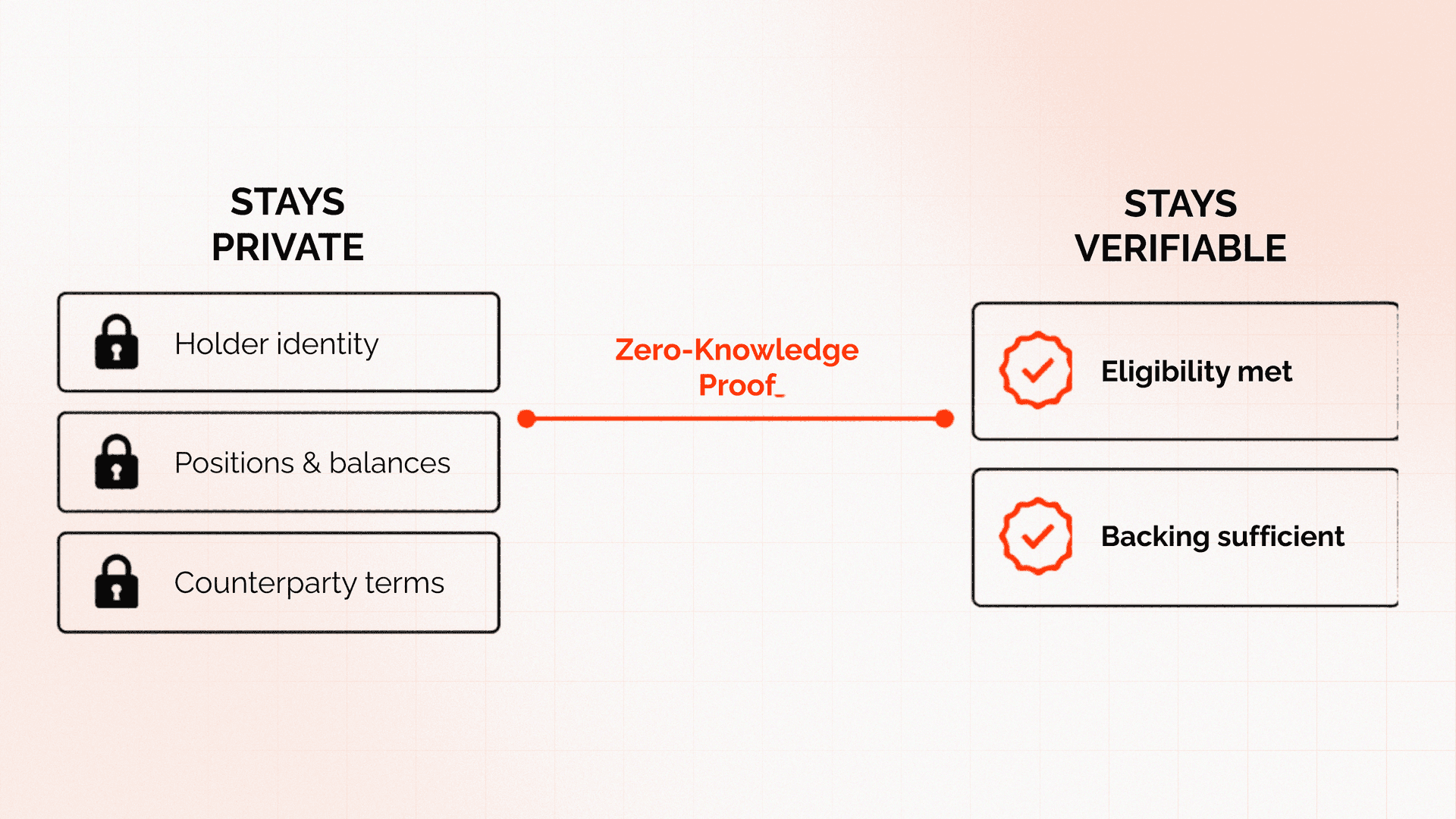 The proof crosses the line; the private data never does.
This is why privacy is the structural blocker, not a feature request. No fund with fiduciary obligations will publish client positions on a transparent ledger, and no serious counterparty will accept an unverifiable claim instead. The resolution has to satisfy both sides at once, which is the case made in how tokenization protects customer data and privacy.
What Tokenized Asset Data Can Stay Private?
Holder identities, individual positions, balances, and specific counterparty terms can often stay private, depending on the verifier, jurisdiction, and disclosure model. None of these need to be public for a regulator or partner to confirm the conditions they actually care about.
A regulator checking eligibility does not need the holder's name and address on-chain; it needs assurance that eligibility was verified. A counterparty assessing a fund does not need every position; it needs assurance that net asset value was calculated correctly. A lender does not need the borrower's full book; it needs assurance that collateral is sufficient. In each case, the sensitive detail is an input to a condition, not the condition itself.
Keeping these private is not evasion. It is the default obligation institutions already operate under, and data-protection frameworks reinforce it. The goal of data privacy compliance is to honor that confidentiality while still producing the assurance the other party needs, the same balance explored in the data privacy compliance proof stack.
What Tokenized Asset Data Must Stay Verifiable?
Eligibility, backing or collateral conditions, and adherence to transfer and reporting rules must stay verifiable. These are the facts that protect investors, counterparties, and the market, and they cannot rest on an unverifiable claim.
Verifiable does not mean public. It means a third party can independently confirm the condition holds. An issuer can make "every holder passed screening" verifiable without revealing who the holders are. A fund can make "this net asset value followed the stated method" verifiable without exposing positions. A platform can make "this transfer respected restrictions" verifiable without publishing the parties. The condition is provable; the data behind it is not disclosed.
Drawing this line clearly is the practical core of data privacy compliance. Once an institution separates "what must be confirmable" from "what must stay confidential," the design problem becomes tractable, and it maps onto the selective-disclosure approach in evidence-first compliance.
How Does Selective Disclosure Resolve the Conflict?
Selective disclosure resolves the conflict by proving a specific condition is true while disclosing nothing else. Built on Zero-Knowledge Proofs, it lets an institution demonstrate that a rule was satisfied without revealing the data that satisfies it.
The mechanism is precise. Rather than sharing a dataset and trusting the recipient to look only at what they should, selective disclosure produces a proof that answers exactly one question, such as "is this holder eligible" or "is backing above the required ratio." The recipient learns the answer and learns nothing about the underlying records. Identities and amounts stay private; the condition stays verifiable.
This is what reconciles transparent ledgers with confidential obligations. The proof goes on-chain, where a verifier with the right access path, such as a counterparty, a smart contract, an auditor, or a regulator under an authorized disclosure model, can check it; the sensitive data never does. For tokenized assets specifically, it means an institution can address verification expectations and confidentiality duties with the same infrastructure, instead of trading one off against the other. The data integrity underneath this still has to be sound, which connects to RWA tokenization data integrity.
Bottom line: Data privacy compliance for tokenized assets is not a choice between privacy and verification. With selective disclosure, identities and positions stay private while eligibility, backing, and rule adherence stay provable. Drawing that line is the whole exercise.
| Data category | Usually private | Verifiable condition | Example verifier |
|---|---|---|---|
| Holder identity | Name, address, documents | Eligibility status | Issuer, auditor, regulator |
| Position data | Holdings, balances | Threshold or NAV condition | Counterparty, smart contract |
| Transfer data | Parties, amounts | Restriction was respected | Platform, regulator |
How Does zkDatabase Support Data Privacy Compliance for Tokenized Assets?
zkDatabase supports it by generating cryptographic proofs of asset and compliance conditions while the underlying data stays private. It applies Zero-Knowledge Proofs across the data pipeline, so an institution can prove eligibility, backing, valuation, or rule adherence on-chain without exposing holder identities, positions, or balances.
In practice, this gives a tokenized asset platform one architecture for addressing both sides of the privacy-versus-verification problem. Authorized verifiers check the proof; the sensitive records never leave the institution's control. The zkDatabase mainnet is live, and the product is built on Zero-Knowledge Proofs with privacy preserved by design.
The boundary is the same as in any compliance context: zkDatabase can provide cryptographic infrastructure that supports data privacy, audit, and reporting workflows. It does not guarantee compliance, replace auditors, or remove legal obligations. It gives institutions a way to keep what should be private private, while making what should be verifiable verifiable.
Conclusion
Data privacy compliance for tokenized assets comes down to drawing one line: identities, positions, and balances can stay private, while eligibility, backing, and rule adherence must stay verifiable. Transparent ledgers and confidential obligations only seem to conflict; selective disclosure resolves them by proving the condition and revealing nothing else. zkDatabase delivers this with Zero-Knowledge Proofs, so institutions can let counterparties and regulators verify the proof while sensitive tokenized asset data stays protected.
Read the docs → See how zkDatabase keeps tokenized asset data private while proving the conditions that matter: https://docs.orochi.network/orochi-network
FAQ
What is data privacy compliance for tokenized assets?
Data privacy compliance for tokenized assets is the practice of meeting verification requirements from regulators and counterparties while keeping holder identities, positions, and balances private. Because tokenized assets sit on transparent ledgers but institutions carry confidentiality obligations, the goal is to prove the conditions that matter, such as eligibility and backing, without exposing the sensitive data behind them.
What tokenized asset data can stay private, and what must be verifiable?
Holder identities, individual positions, balances, and counterparty terms can stay private. Eligibility, backing or collateral conditions, and adherence to transfer and reporting rules must stay verifiable. Verifiable does not mean public: a third party can confirm a condition holds without seeing the underlying records, which is the line data privacy compliance is built around.
How does selective disclosure work for tokenized assets?
Selective disclosure uses Zero-Knowledge Proofs to prove a specific condition is true while revealing nothing else. Instead of sharing a dataset, an institution produces a proof that answers one question, such as whether a holder is eligible or whether backing exceeds a threshold. The recipient learns the answer and nothing about the underlying data, keeping identities and amounts private.
Does zkDatabase guarantee data privacy compliance for tokenized assets?
No. zkDatabase does not guarantee compliance or remove legal obligations. It provides cryptographic infrastructure that can support data privacy, audit, and reporting workflows by proving asset and compliance conditions with Zero-Knowledge Proofs while keeping the underlying data private. Institutions remain responsible for compliance, and auditors and regulators continue to play their roles.
Related toData Privacy