Real - World Assets
The RWA Activation Gap: Why Only 9% of Tokenized Assets Work in DeFi
October 22, 2026
9 mins read
More than $20B in real-world assets has been tokenized, but only around 9% is actively used in DeFi. The blocker is no longer issuance. It is whether the asset's off-chain state can be verified continuously enough for a risk manager to finance it.


The RWA Activation Gap: Why Tokenized Assets Sit Idle in DeFi
Last updated: 2026-06-23
More than $20 billion in real-world assets has been issued on-chain, yet only around 9% is actively used in DeFi. Tokenization solved how to mint the asset. It did not solve whether anyone can verify the asset well enough to lend against it.
TL;DR: Tokenized RWA in DeFi has crossed $20B in issuance, but only about 9% is actively deployed in lending and collateral markets as of March 2026. Issuance is a solved problem; activation is not. The remaining gap is verification: a risk manager will only finance a tokenized asset whose off-chain state can be proven continuously, not attested quarterly.
Issuance of tokenized RWA in DeFi has outrun actual usage by an order of magnitude, and that gap is now the industry's real bottleneck. zkDatabase addresses the missing piece by making an asset's off-chain state verifiable on-chain. The result is collateral a risk manager can underwrite without trusting a quarterly report.
Key Takeaways
- Tokenized RWA in DeFi has surpassed $20B in issuance, but only around 9% is actively used in lending or collateral markets (4Pillars, March 2026).
- The active RWA market cap reached roughly $25.2B by March 2026, while only about $2.81B sits inside DeFi protocols (DefiLlama State of RWAfi, Q1 2026).
- Operators now say distribution matters more than issuance: 86% rank scaling distribution above launching new products (Centrifuge Tokenization Outlook 2026).
- The headline blockers are regulation and liquidity. Underneath them sits a verification problem: conservative risk parameters persist when the collateral's state cannot be continuously proven.
- zkDatabase turns off-chain asset data into Verifiable Data, so a lending market can confirm collateral condition without exposing the underlying records.
What is the RWA activation gap in DeFi?
The RWA activation gap is the distance between how much real-world value has been tokenized and how little of it is actually used inside DeFi. As of March 2026, issuance passed $20B while active utilization sat near 9%, according to 4Pillars research. The asset exists on-chain. It just does not move.
DefiLlama's State of RWAfi puts the same gap in different numbers: active RWA market cap expanded from about $4.1B in early 2025 to roughly $25.2B by March 2026, but only around $2.81B of that is deployed within DeFi protocols. Tokenized funds account for more than half of the active market cap at $13.5B, with commodities at $5.9B and private credit near $4.6B. The supply side is healthy. The usage side is thin. For the wider picture, see how TradFi and DeFi converge in RWA tokenization.
This is the part the market underestimated. Minting a token that represents a treasury bill or a private loan is now routine. Getting a lending protocol to accept that token as collateral at meaningful scale is not.
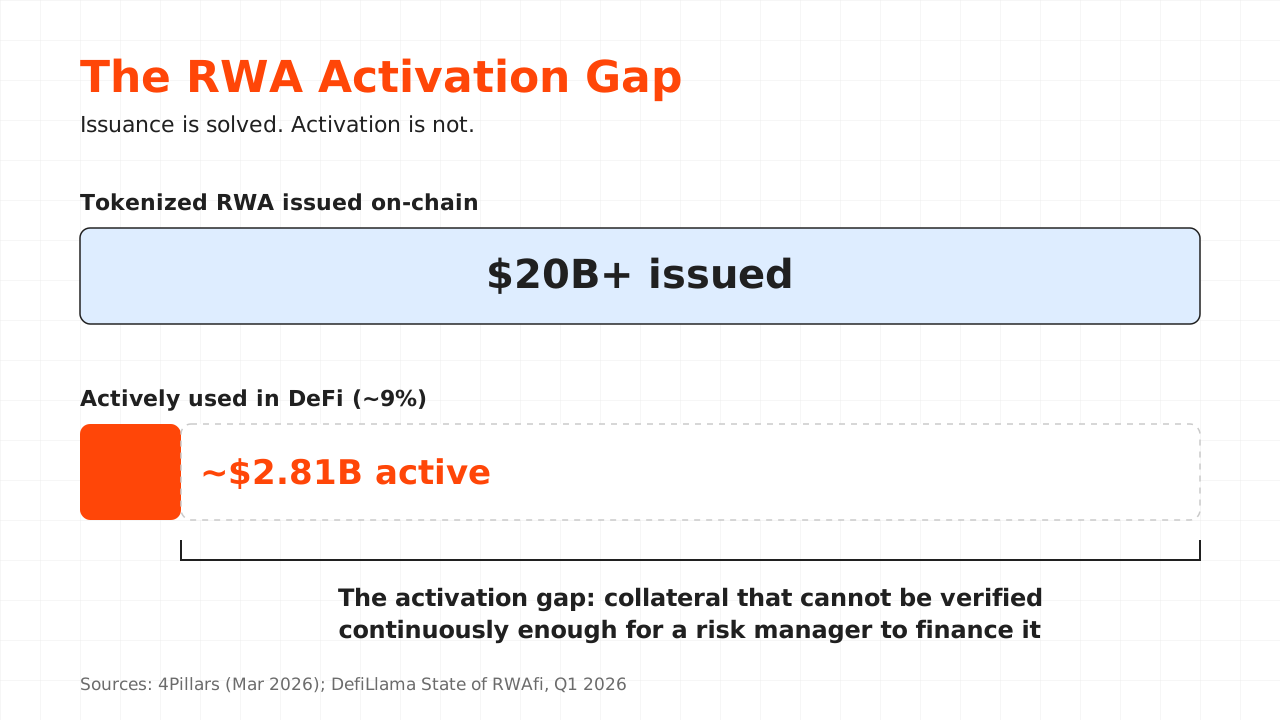 Issuance has outrun activation: more than $20B in real-world assets is tokenized, but only around 9% is actively financed in DeFi.
Why does tokenized RWA stay idle instead of moving into lending markets?
Tokenized assets sit idle because the rest of the stack cannot verify them cheaply enough to take risk against them. A lending market prices collateral by what it can confirm. When confirmation depends on a custodian's report or a periodic attestation, risk managers compensate with conservative parameters: low loan-to-value, tight caps, or no listing at all.
The result shows up as single-digit utilization across many RWA lending markets, constrained by shallow liquidity and cautious risk settings rather than lack of demand. The capital is interested. The collateral is just hard to underwrite.
| Lifecycle stage | What the protocol needs to know | Typical source today | Gap |
|---|---|---|---|
| Onboarding | Does the token represent a real, segregated asset? | Legal opinion, custodian letter | Point-in-time, off-chain |
| Pricing | Is the NAV current and correct? | Daily oracle feed | Updates lag continuous markets |
| Monitoring | Has collateral quality changed since listing? | Quarterly report | Blind between reports |
| Liquidation | Can the on-chain value be trusted at the moment of action? | Oracle snapshot | Inherits upstream trust |
Each row is a place where a risk manager has to substitute trust for proof. That substitution is the tax that keeps utilization low.
Is tokenization a technical problem or a market-structure problem?
Operators are clear that the binding constraints are market structure, not blockchain capability. In Centrifuge's 2026 operator survey, 76% cited regulatory clarity and liquidity depth as the biggest bottlenecks, and 86% said scaling distribution matters more than launching new products. The infrastructure works; the rules and the demand are catching up.
That finding deserves to be taken at face value, not bent into a product pitch. zkDatabase does not fix liquidity and it does not write regulation. What it changes is narrower and specific: the cost of verifying an asset's state. When a risk manager can confirm collateral condition continuously instead of trusting a report, the conservative parameters that throttle utilization have less reason to stay conservative.
The market has moved past "can this be tokenized?" The live question is what happens after issuance: can the asset be posted as collateral, settle into a lending market, and support reporting without manual reconciliation? That is a data question.
How does verifiable data raise RWA utilization?
Verifiable data raises utilization by removing the trust assumptions a risk manager would otherwise price as risk. Instead of publishing a value and asking the protocol to trust it, zkDatabase generates a proof that the underlying data satisfies the stated condition, and an on-chain contract checks the proof. The asset arrives with evidence attached.
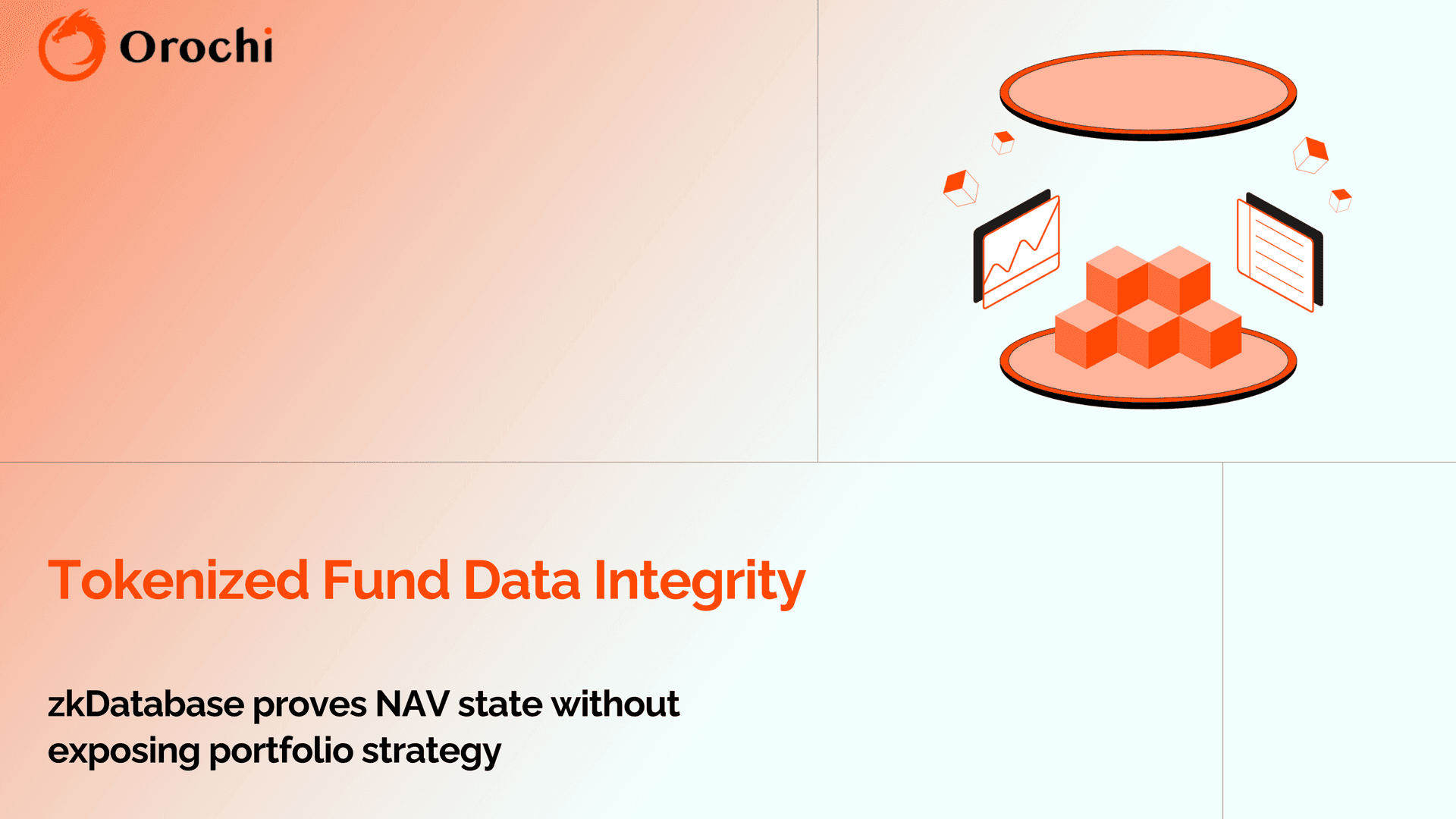
For a tokenized fund used as collateral, that means proving NAV was computed correctly without exposing the position book. For tokenized private credit, it means proving that borrower-level performance and covenant status hold, without publishing the loan tape. The lending market verifies the condition; the sensitive record stays private. This is the practical meaning of RWA DeFi collateral data integrity at the layer where collateral is actually financed.
zkDatabase does not replace the auditor or the custodian. It gives them, and every downstream protocol, a record that can be verified without trusting whoever produced it. That is the difference between an asset that is issued and an asset that is financeable.
Bottom line: The activation gap is not a demand problem. It is a verification cost that shows up as conservative risk parameters, and cryptographic proof is the most direct way to lower it.
How does zkDatabase fit the tokenized RWA stack?
zkDatabase sits between an asset's off-chain data and the on-chain protocols that need to trust it, turning reported state into Verifiable Data. It is positioned for the exact handoff where utilization stalls: the moment a lending market or curator decides whether tokenized collateral is safe to finance.
- Pain: risk managers apply conservative parameters because collateral state is only attested, not proven.
- Mechanism: zkDatabase produces Zero-Knowledge Proofs over the asset's data pipeline, from ingestion to on-chain verification.
- Outcome: protocols verify NAV, reserves, ownership, or covenant status continuously, without exposing the records behind them.
The same pattern extends to tokenized fund data integrity and to NAV lag in tokenized funds used as collateral, where the cadence between off-chain reporting and on-chain markets is exactly where risk hides.
Conclusion
Tokenized RWA in DeFi has a supply surplus and a usage deficit: more than $20B issued, roughly 9% active. Issuance was the first decade's problem and the market solved it. Activation is the next one, and it turns on whether an asset's off-chain state can be verified continuously enough for a risk manager to underwrite it. Verifiable Data Infrastructure is how that verification gets cheap enough to move idle collateral into live markets. zkDatabase is built to close exactly that gap, by making the data behind every tokenized asset provable on-chain.
Explore zkDatabase
See how a Verifiable Data Pipeline turns tokenized asset data into collateral a lending market can underwrite.
FAQ
What is tokenized RWA in DeFi?
Tokenized RWA in DeFi refers to real-world assets, such as treasuries, private credit, or commodities, that have been issued on-chain and used inside DeFi protocols as collateral, lending supply, or composable instruments. As of March 2026, more than $20B has been tokenized, but only around 9% is actively deployed, because issuance has outpaced the market's ability to verify and finance the assets.
Why is only 9% of tokenized RWA used in DeFi?
Only about 9% of tokenized RWA is active in DeFi because risk managers cannot verify collateral state cheaply enough to finance it at scale. When asset condition depends on periodic attestation rather than continuous proof, lending markets apply conservative parameters, low caps, and tight loan-to-value ratios. The constraint is verification cost and market structure, not demand for the assets.
Does better verification fix RWA liquidity and regulation?
No. Verification does not create liquidity or write regulation, which operators cite as the main bottlenecks. What verifiable data changes is narrower: it lowers the trust assumptions a risk manager prices as risk. Continuous cryptographic proof of collateral state lets protocols relax the conservative parameters that keep utilization low, which supports, but does not replace, deeper liquidity and clearer rules.
How does zkDatabase make tokenized assets financeable?
zkDatabase generates Zero-Knowledge Proofs over an asset's off-chain data, so a protocol can verify NAV, reserves, ownership, or covenant status on-chain without seeing the underlying records. This converts attested collateral into Verifiable Data, giving risk managers continuous evidence instead of periodic reports, which is the condition for moving idle tokenized assets into active lending and collateral markets.
Related toReal - World Assets