About zkDatabase
What is Orochi Network ?
July 30, 2026
13 mins read
Orochi Network is the Verifiable Data Infrastructure for RWA, Stablecoins, Capital Markets, and On-chain Credit - transforming raw data into cryptographically verifiable data for institutional Web3.


TL;DR: Institutional Web3, across RWA, stablecoins, capital markets, and on-chain credit, runs on off-chain data that smart contracts cannot trust by default. Orochi Network closes that gap with zkDatabase, which proves off-chain data is authentic and that operations ran correctly, without exposing the underlying data. The result is data an on-chain contract can rely on, not just a report to trust.
Orochi Network is the Verifiable Data Infrastructure that transforms raw data into verifiable data, built for Real-World Asset tokenization, Capital Markets, Stablecoins, and On-chain Credit. Backed by $20M in funding from the Ethereum Foundation and leading VCs, Orochi also supports a growing community of 500K+ members and 140+ projects across its ecosystem, while Orand and Orocle extend verifiability across 49+ chains. By combining Proof-Carrying Data with Zero-Knowledge Proof systems like Halo2, Plonky3, Nova, Pickles, and Groth16, Orochi delivers audit-grade integrity and slashes Ethereum data costs from ~$25 to ~$0.002 per KB, a 12,500x reduction.
What is Orochi Network?
Orochi Network is a Verifiable Data Infrastructure designed for Real-World Assets, Stablecoins, Capital Markets, and On-chain Credit, enabling data systems where integrity, security, and interoperability can be proven cryptographically rather than assumed.
At its core, Orochi Network ensures:
- Verifiable Data Integrity: Cryptographic primitives guarantee that data authenticity and correctness can be independently verified.
- Proof-Based Security: Verifiable computations enable a proof-of-everything model, replacing trust-based assumptions with cryptographic proof.
- Seamless Interoperability: A proof-agnostic architecture allows integration across multiple ecosystems using Zero-Knowledge Proofs and ZK-Data-Rollups.
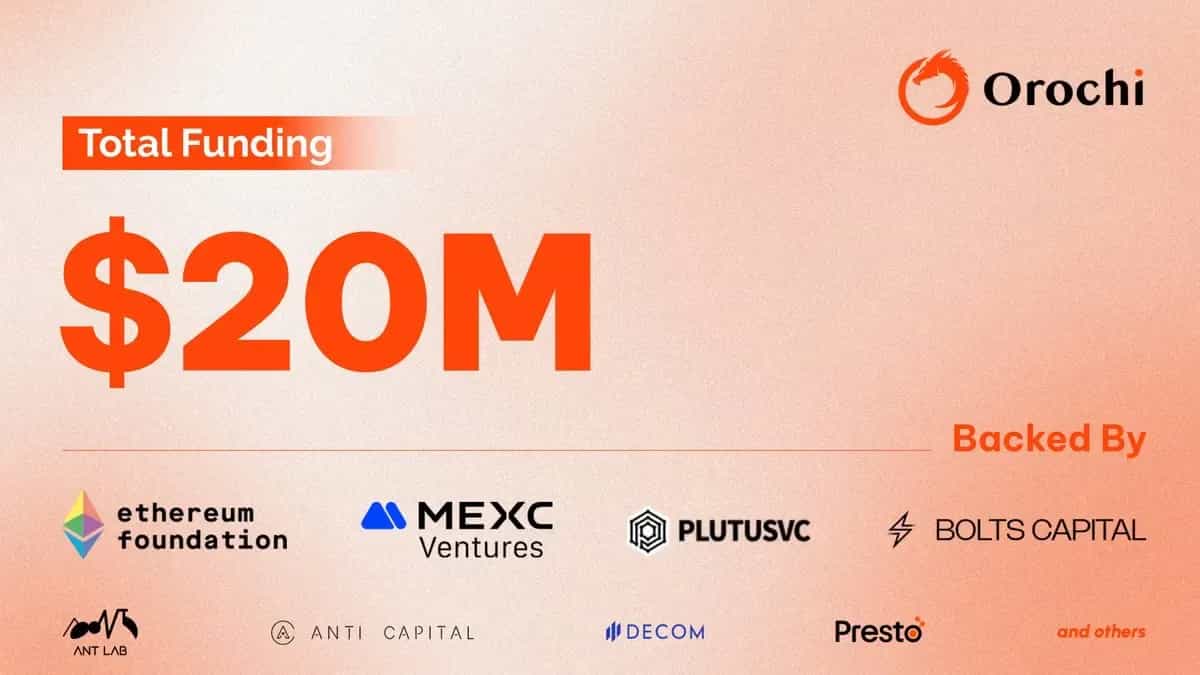
Orochi Network is the Verifiable Data Infrastructure to ensure data integrity and privacy through advanced cryptographic techniques such as Zero-Knowledge Proofs (ZKP), FHE, and TEEs. Backed by $20M in funding from the Ethereum Foundation and leading VCs, Orochi Network provides a secure infrastructure for processing and proving data without compromising confidentiality. Allowing users to trust the system's outputs while keeping sensitive information protected - making it a powerful solution for enterprises and applications requiring both transparency and privacy.
Orochi's zkDatabase turns data into Verifiable Data, the data with cryptographic proof that can be verified by on-chain smart contracts, for use cases across real-world assets, tokenized, capital markets, stablecoins, on-chain credit, and DeFi.
By combining Proof-Carrying Data (PCD) with multiple zero-knowledge proof systems (Halo2, Plonky3, Nova, Pickles, and Groth16), Orochi delivers audit-grade data integrity, seamless multi-chain interoperability, and materially lower settlement costs - reducing the effective price of anchoring 1 KB on Ethereum from c. US $25 to roughly US $0.002, a 12,500x reduction.

The Problem of The Market Data Integrity
Blockchain systems still struggle to deliver scalable, secure, and Verifiable Data Infrastructure for real-world adoption. Core challenges persist across smart contract security, data integrity, data availability, interoperability, and scalability, preventing decentralized systems from supporting enterprise-grade use cases.
Security
While blockchains are secure at the consensus level, application-layer security remains fragile. Poorly designed smart contracts can be exploited, leading to costly breaches and eroding trust. Additionally, constrained on-chain computation makes complex verification prohibitively expensive, forcing applications to rely on off-chain processing that reintroduces trust assumptions and verification gaps.
Data Integrity
In an ideal decentralized environment, data integrity would be ensured by distributed verifiers that can independently confirm correctness using cryptography. However, most Web3 systems today rely on oracle-based architectures, which act as intermediaries rather than proof systems.
Because smart contracts cannot natively verify third-party data, systems remain exposed to manipulation, fraud, and financial loss, especially as data volumes grow or sensitive datasets must remain private.
Data Availability
Smart contracts operate within sandboxed environments such as the EVM or WASM runtimes. While this abstraction enables portability, it severely limits direct interaction with real-world data.
As the number of users and transactions increases, storing and retrieving all data on-chain becomes impractical and costly. Existing data availability approaches struggle to balance scalability, cost efficiency, and verifiability.
Interoperability
Interoperability is critical for decentralized systems but remains constrained by the lack of standardization across architectures. Current Data Availability layers rely on commitment schemes that do not provide smart contracts with concise, single-proof representations of global data states.
This limitation prevents seamless cross-chain verification and undermines composability across ecosystems.
Scalability
Many Data Availability layers inherit the fundamental limitations of the blockchains they are built on, including slow finality and restricted throughput. These systems are unable to release locked resources efficiently or achieve instant finality under Byzantine Fault Tolerant (BFT) consensus.
As transaction volumes increase, scalability constraints drive higher costs and reduced performance, preventing decentralized systems from supporting large-scale, real-world workloads.
The Solution
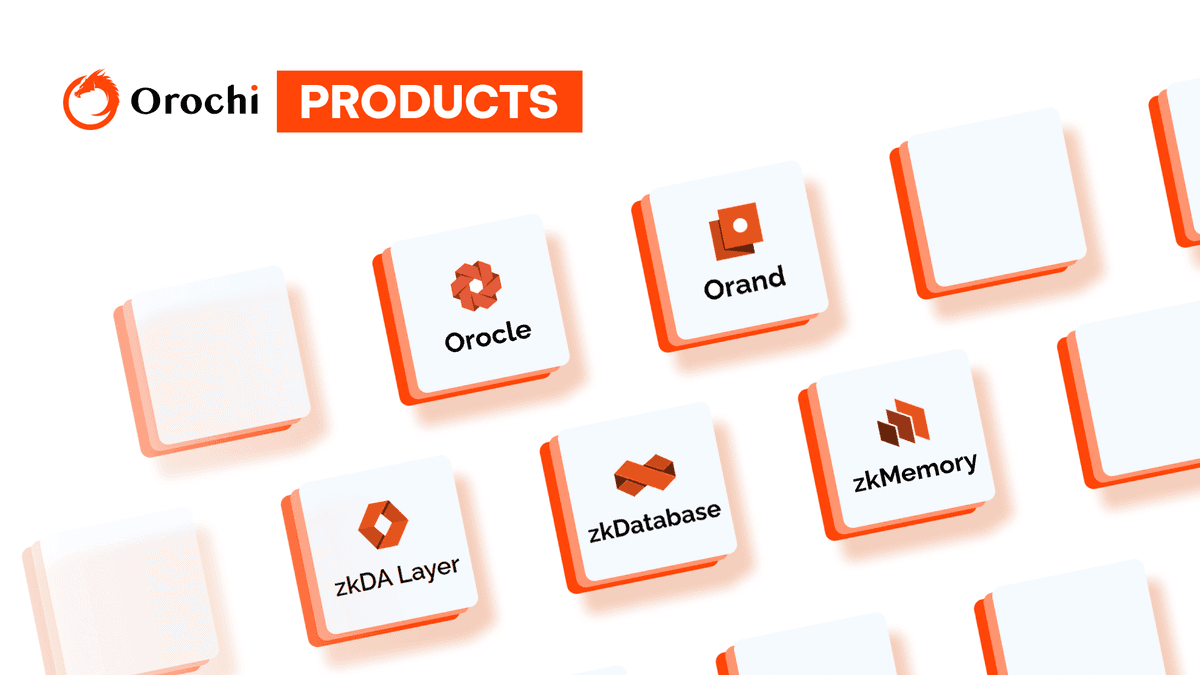
To address the pressing challenges in blockchain technology, such as security, scalability, and data integrity, innovative solutions like zkDatabase, zkDA Layer, zkMemory, Orand, and Oracle offer targeted advancements for a robust Web3 ecosystem.
-
zkDatabase bolsters security for smart contract platforms by enabling data verification without exposure, mitigating risks of breaches or unauthorized access, while enhancing scalability through Zero-Knowledge Proofs that efficiently manage larger datasets.
-
zkDA Layer empowers users with private key ownership, granting full control over their data, secured and anonymized via encryption.
-
zkMemory, a critical feature for specific blockchain operations, optimizing cost efficiency and object storage.
-
Orand provides independently verifiable epochs, either externally or via smart contracts, ensuring reliability.
-
Orocle operates on a provable model, minimizing single points of failure and fostering trust with a distributed node network, delivering real-time, accurate data feeds tailored for dynamic Web3 applications.
Together, these solutions pave the way for more secure, scalable, and trustworthy decentralized systems.
What Are the Core Products of Orochi Network?
Orochi Network offers a comprehensive suite of core products designed to build a fully verifiable data infrastructure. These essential components enable verifiable proof of data integrity, availability, interoperability, and privacy across Web3 applications, AI systems, and Real World Assets (RWA).
zkDatabase
zkDatabase is a specialized database system tailored for blockchain environments, harnessing Zero-Knowledge Proofs (ZKPs) to deliver enhanced data integrity, security, and scalability. It provides faster processing and reduced costs for blockchain applications while granting data owners full control over our database instances, ensuring compliance with regional regulations through complete database encryption.

At its core, zkDatabase is built around a Zero-Knowledge Proof that enables cryptographic verification of all data operations, with key technical capabilities including:
- Groth16-based zk-SNARK verification, providing constant 192-byte proofs and extremely fast, low-cost verification, making it highly practical for on-chain and blockchain-integrated use cases.
- Production-optimized proof selection, where Groth16 was chosen after extensive benchmarking against alternative proof systems (including Kimchi, PLONK, and STARK-based approaches), consistently outperforming them in proof size, verification cost, and end-to-end latency for Merkle membership proofs.
- ~0.4s end-to-end proving time for Merkle membership circuits (sub-0.5s), with on-chain EVM verification at approximately 100K–150K gas.
- In this context, Groth16 offers an optimal balance between cryptographic soundness and operational efficiency, making it a strong foundation for a provable database system today, while still allowing room for future evolution.
zkDatabase has processed over 274,000 operations with an exceptionally low error rate of just 0.0025%, caused by a single queue sequence gap. It supports a wide range of operations, over 70,000 READs, 88,000 INSERTs, 107,000 UPDATEs, and nearly 8,000 DELETEs.
Write performance remains stable across batch sizes up to 100K documents, averaging ~20 docs/sec with ~50ms per document. Query speed consistently stays under 15ms, even with datasets exceeding 100K records.
zkDatabase is already powering real-world applications such as OG Labs, Skatechain, and other next-gen Web3 platforms, demonstrating its scalability, resilience, and readiness for high-integrity data needs in production environments.
zkDA Layer
In the zkDA Layer, users control their data with private keys, while encryption ensures security and anonymity. Orochi Network pioneers the Data Availability Layer (DAL) space as the first zkDA Layer, using Zero-Knowledge Proofs (ZKP) for efficient, verifiable data processing. It natively supports ZK-data-rollups for scalable, private applications and provides a verifiable data pipeline with cryptographic proofs at every step, sampling, storage, and retrieval.
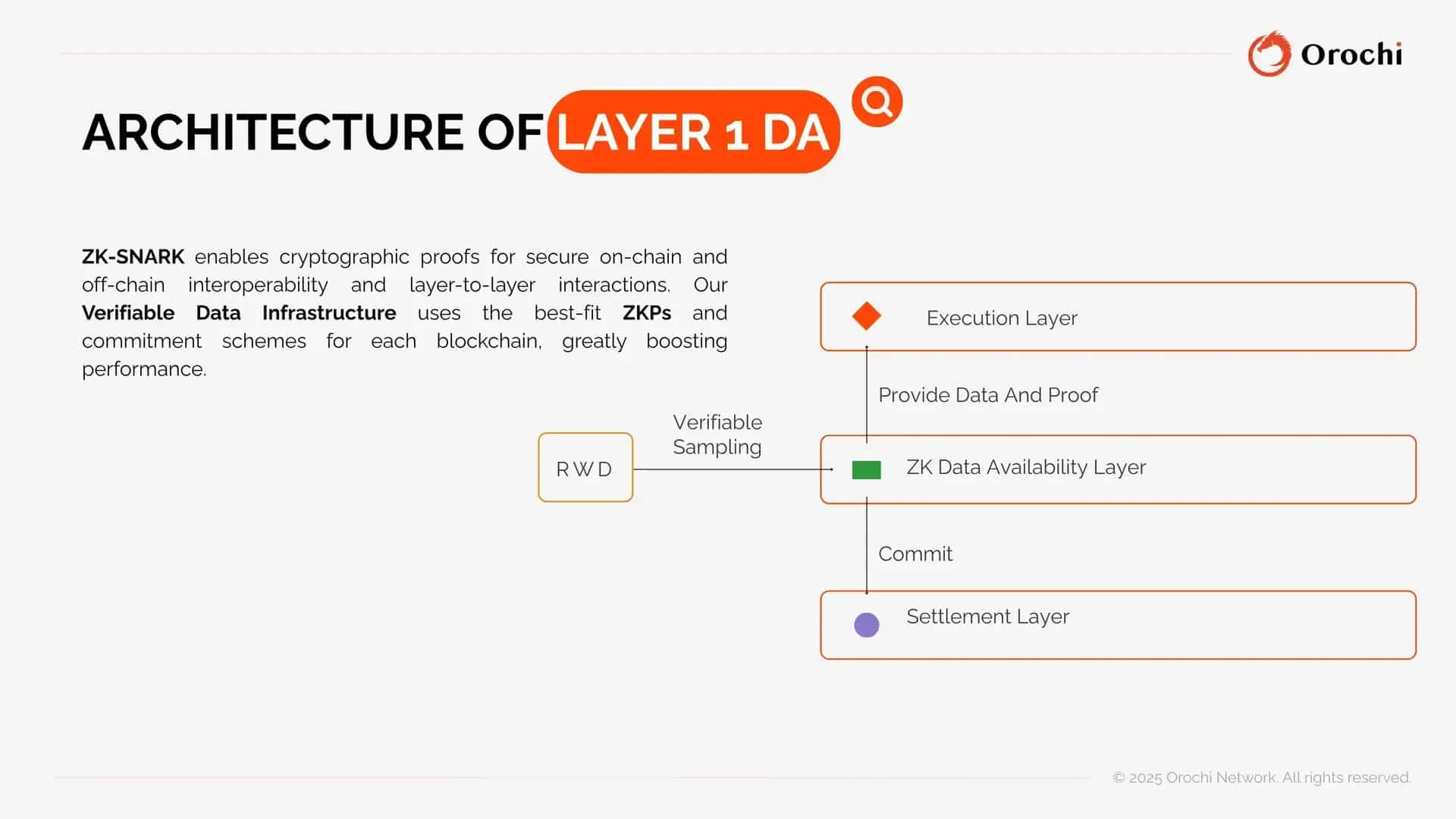
This enhances trust and transparency. Flexible and blockchain-agnostic, it works with various Zero-Knowledge Proof systems (e.g., Halo2, Plonky3, Nova, Pickles) and platforms. Its succinct hybrid aBFT consensus and Directed Acyclic Graph (DAG) technology boost scalability and efficiency, making Orochi a privacy-focused, trust-driven solution for blockchain applications.
By leveraging the capabilities of Zero-Knowledge Proofs, it provides a robust solution to some of Web3's most daunting challenges, enhancing security and scalability. This revolutionary layer opens the door to secure, scalable, and user-friendly decentralized applications (dApps), addressing limitations in current systems.
Orocle
Orocle is an advanced oracle service that retrieves and validates off-chain data for blockchain smart contracts, moving beyond the vulnerabilities of traditional centralized oracles with a provable, decentralized model that reduces single points of failure and builds trust through a distributed network of nodes.
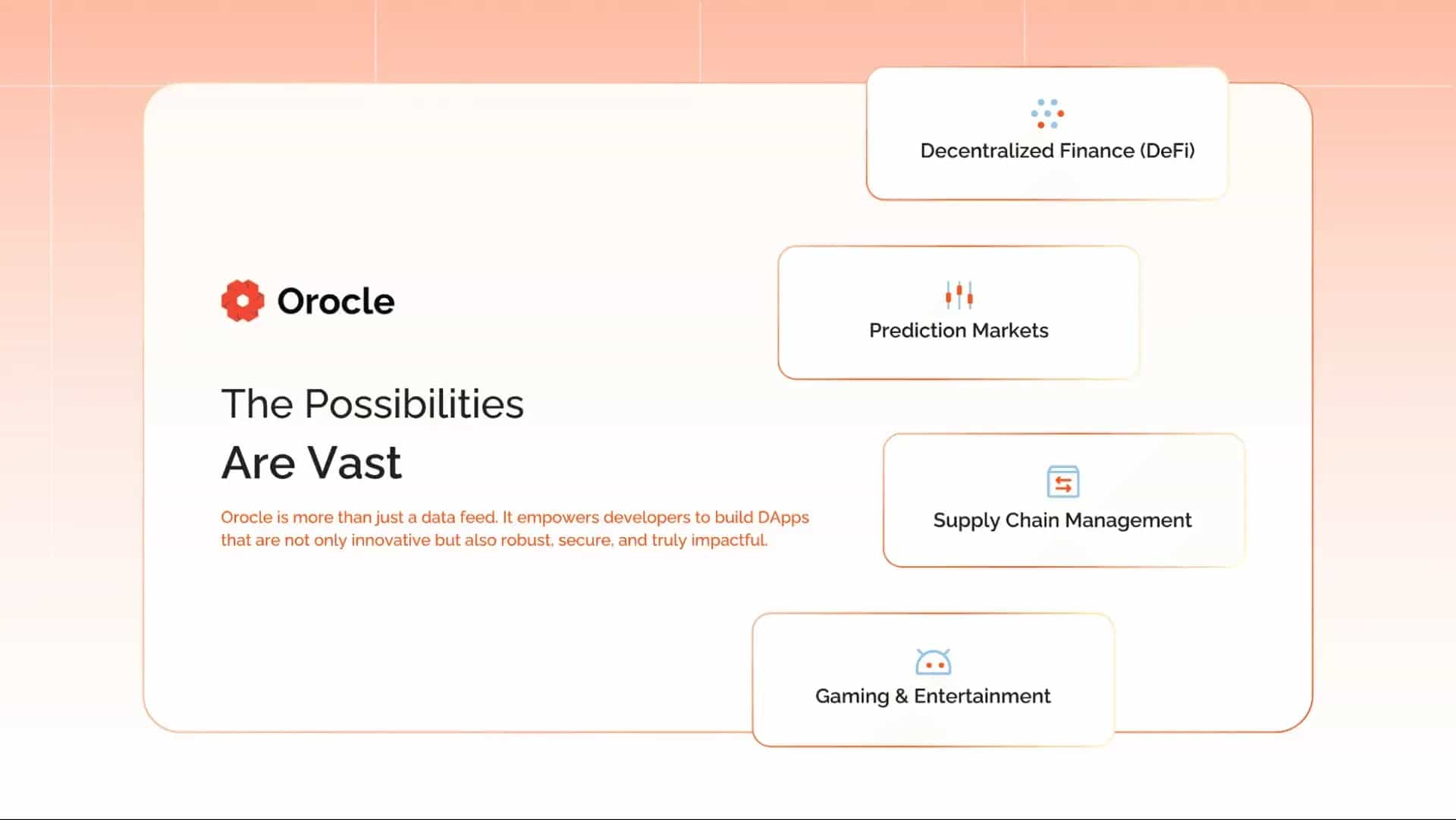
Designed for the Web3 ecosystem, it delivers real-time, accurate data feeds to power dynamic applications, while also serving as a cross-sell product that enhances smart contracts with external data and a Verifiable Random Function (VRF), powered by our Rust-based libecvrf library, for generating provably fair random numbers essential for smart contracts and Web3 games.
Orand
Orand is a Verifiable Randomness service developed by Orochi Network. It provides cryptographically provable random numbers that smart contracts and decentralized applications can trust, without relying on centralized sources or opaque off-chain processes.
zkMemory
zkMemory is a versatile module that can be seamlessly integrated into various zkVM projects, ensuring secure and efficient Memory Prover.
Use Case of Orochi Network
As Web3 expands into finance and regulated industries, decentralized systems increasingly depend on off-chain and real-world data. Orochi Network enables these systems to operate securely by transforming external data into cryptographically verifiable inputs that smart contracts can trust without relying on intermediaries.
RWA
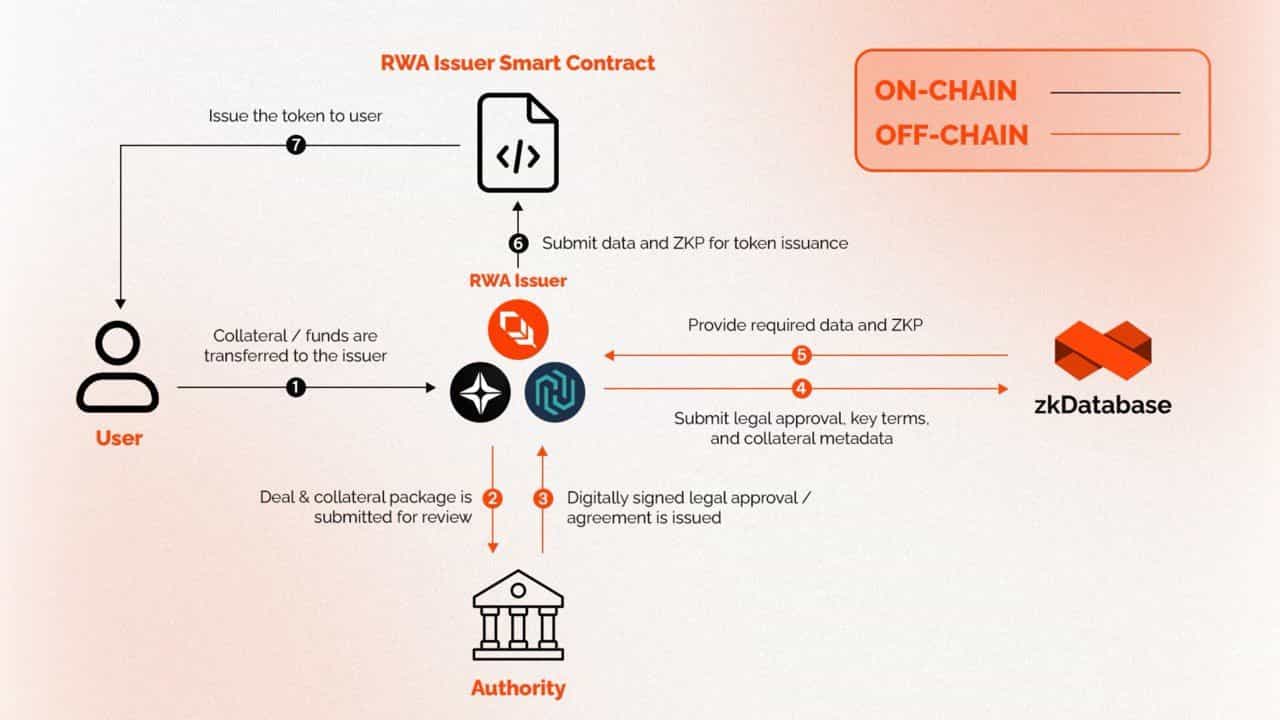
RWA requires verifiable proof that off-chain assets, legal approvals, and collateral terms are valid before tokens are minted on-chain. In this flow, asset metadata, legal agreements, and collateral details are submitted off-chain and stored in zkDatabase, where zero-knowledge proofs are generated to attest compliance and asset backing.
These proofs are then verified by on-chain smart contracts, enabling token issuance only when legal and collateral conditions are cryptographically satisfied, without exposing sensitive legal or financial data.
Stablecoins
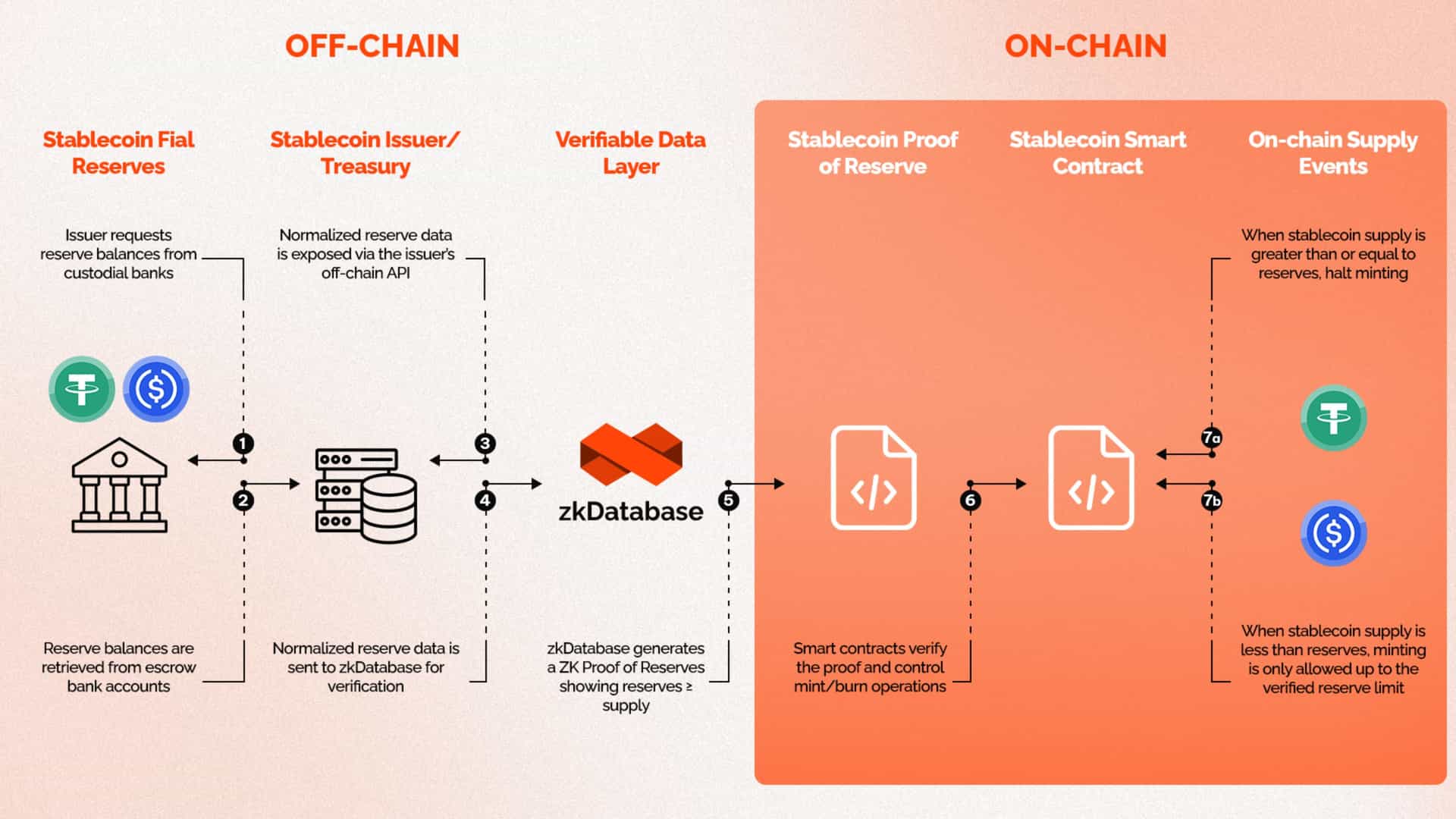
With the GENIUS Act signed into law and MiCA fully applicable since December 2024, stablecoin issuers now face binding requirements for reserve verification and ongoing transparency, not just periodic attestations. Stablecoins must prove that reserves exceed a defined safety threshold while meeting liquidity, diversification, and compliance rules, without revealing bank accounts or positions. zkDatabase serves as a stablecoin reserve assurance layer by enabling issuers to verify solvency using zero-knowledge proofs instead of raw financial data. This allows mint and burn operations to be enforced by proof validity, reducing trust assumptions and operational overhead.
On-chain Credit
Every credit signal comes with a privacy cost. Even "on-chain" credit still relies on off-chain, highly sensitive data (income, credit histories, internal scores) and manual workflows that are not cryptographically tied to the loan, making underwriting decisions, collateral validation, and covenant monitoring difficult to verify in real time.
zkDatabase lets lenders use both on-chain and off-chain credit signals without turning user data into a public dataset. It supports flexible data collection for credit scoring by generating zero-knowledge proofs
- Verifiable underwriting: proves KYC/KYB, sanctions checks, and eligibility rules were completed correctly, without sharing the underlying files.
- Private repayment reputation + Consent-based offchain data: Converts repayment behavior and consent-based offchain data into usable credit signals - so borrowers can share only what's needed (e.g., income range, employment status, credit tier) to qualify for better rates and limits, without exposing transaction-by-transaction history.
- Privacy-preserving audit trail: produces proofs that decisions followed the agreed policy and data requirements, so trust is verifiable onchain without revealing sensitive records.
Capital Market
Capital markets demand strict guarantees around data integrity, settlement correctness, and regulatory compliance. As financial instruments move on-chain, institutions must prove portfolio states, trade execution, and risk constraints without exposing proprietary information. The infrastructure gap is real: tokenization platforms are scaling faster than the data verification layer beneath them, and regulators are no longer willing to accept periodic attestations as sufficient assurance.
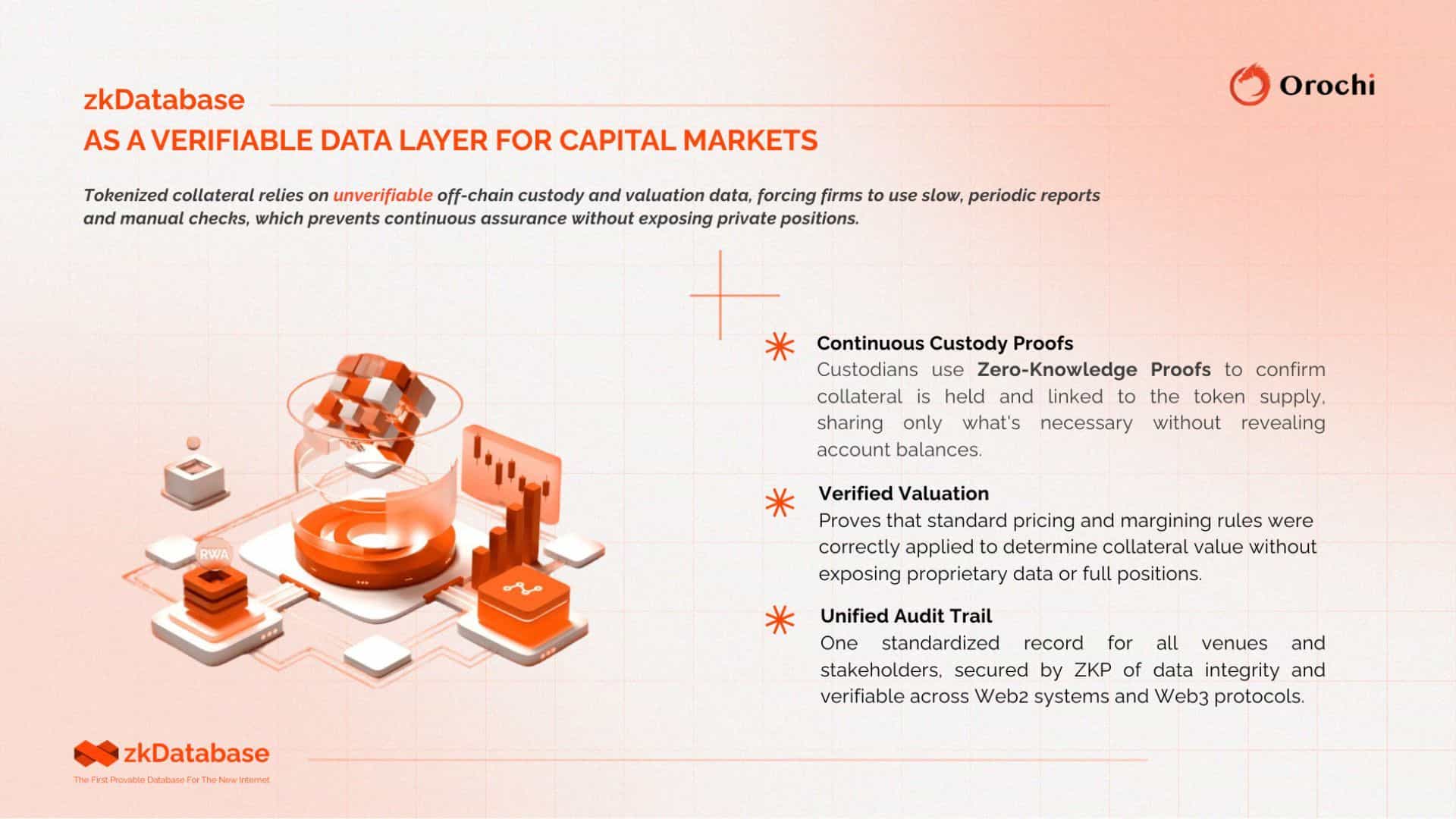
Orochi Network supports capital market infrastructure by enabling verifiable off-chain computation with on-chain verification. This allows scalable market operations while maintaining audit-grade correctness and compliance.
Closing Thought
Orochi Network stands at the forefront of Verifiable Data Infrastructure, delivering scalable, privacy-preserving, and audit-grade solutions for Web3 and beyond. Backed by the Ethereum Foundation and integrated across 140+ projects on Orochi Network, Orochi's ecosystem, including zkDatabase, zkDA Layer, zkMemory, Orand, and Orocle, solves critical challenges in data integrity, scalability, and compliance and RWA tokenization.
Looking ahead to 2026, the evolution of zkDatabase represents a broader shift toward proof-based data systems, where data integrity is enforced by cryptography. As decentralized applications continue to intersect with regulated industries and real-world data, Orochi Network is positioned to play a critical role in shaping infrastructure that is secure, verifiable, and built for long-term adoption.
FAQs
What is Orochi Network?
Orochi Network is a Verifiable Data Infrastructure designed to ensure data integrity, privacy, and trust in Web3 applications using advanced cryptographic techniques. At its core, it lets systems process and prove data cryptographically without exposing sensitive information, solving challenges in decentralization around data transparency and trust.
What is the "zkDatabase" and how is it used?
The zkDatabase is Orochi's core product. It allows developers to store and manage data off-chain while providing a Zero-Knowledge Proof to verify every operation (READ, INSERT, UPDATE, DELETE) on-chain. This ensures that the data is tamper-proof without requiring the high costs of on-chain storage.
It has processed over 274,000 operations with a near-perfect success rate (99.9975%).
What are the primary use cases of Orochi Network?
Orochi Network focuses on providing Verifiable Data Infrastructure for four high-impact sectors: Real-World Assets (RWA), Stablecoins, On-chain Credit, and Capital Markets.
By using Zero-Knowledge Proofs (ZKP) and its core product, zkDatabase, Orochi ensures that off-chain data can be verified on-chain with mathematical certainty, security, and privacy.
At its core, Orochi Network remains dedicated to privacy-preserving data by leveraging Zero-Knowledge Proofs (ZKP) and Fully Homomorphic Encryption (FHE) to ensure that sensitive information, from credit scores to asset deeds, can be verified on-chain with absolute mathematical certainty without ever exposing the raw data to the public.
slug: what-is-orochi-network
excerpt: Orochi Network is the Verifiable Data Infrastructure for RWA, Stablecoins, Capital Markets, and On-chain Credit, transforming raw data into cryptographically verifiable data for institutional Web3.
Related toAbout zkDatabase