



Stablecoin
MiCA Stablecoin Compliance: What Issuers Must Prove by July 2026
May 26, 2026
11 mins read
MiCA's full enforcement deadline hits July 1, 2026. Stablecoin issuers face fines up to 12.5% of annual turnover for non-compliance. Most still rely on periodic attestations, but MiCA demands continuous reserve transparency, machine-readable reporting, and six-month independent audits. The gap between current attestation practices and MiCA's requirements is a verification infrastructure problem that cryptographic proof can solve.


TL;DR: MiCA's full enforcement deadline hits July 1, 2026. Stablecoin issuers face fines up to 12.5% of annual turnover for non-compliance. Most still rely on periodic attestations, but MiCA demands continuous reserve transparency, machine-readable reporting, and six-month independent audits. The gap between current attestation practices and MiCA's requirements is a verification infrastructure problem that cryptographic proof can solve.
Key Takeaways
- MiCA stablecoin compliance carries fines up to 12.5% of annual turnover, with full enforcement beginning July 1, 2026
- Quarterly or monthly attestations don't meet MiCA's continuous reserve transparency standard
- ESMA's machine-readable JSON schemas and iXBRL taxonomy, mandatory since December 2025, signal a shift toward automated compliance infrastructure
- Independent audits every six months under Article 36.9 create capacity bottlenecks at scale
- Cryptographic verification infrastructure closes the gap between periodic attestation and continuous proof
What does MiCA actually require from stablecoin issuers?
MiCA requires stablecoin issuers to maintain continuous reserve transparency, submit to independent audits every six months, and deliver reporting in machine-readable formats. These requirements go beyond the industry's current attestation-based standard in ways that most issuers have not yet operationalized.
What are the reserve composition and custody rules?
Under MiCA (Markets in Crypto-Assets Regulation), issuers of E-Money Tokens (EMTs) and Asset-Referenced Tokens (ARTs) must hold 30 to 60 percent of reserves in EU bank accounts. The European Banking Authority (EBA) and the EU Commission still dispute the exact boundaries of eligible reserve assets, creating uncertainty for issuers designing their custody architecture.
The licensing burden compounds this. Issuers need both a MiCA CASP authorization and a PSD2 payment license, with cumulative capital requirements exceeding €250,000 for the same stablecoin activity. One major issuer publicly called this dual-licensing structure a "regulatory own goal." Fourteen cryptocurrency exchanges have secured full CASP authorization as of March 2026, but the issuer side lags behind. Only 19 authorized EMT issuers exist across the EU, and zero Asset-Referenced Token issuers have been approved.
What does "continuous transparency" mean in practice?
MiCA's transparency standard isn't satisfied by publishing a monthly PDF. Since December 2025, ESMA (European Securities and Markets Authority) has required machine-readable JSON schemas and iXBRL taxonomy for regulatory reporting. This signals a clear direction: compliance data should be structured, automated, and verifiable on demand.
Article 36.9 requires independent audits every six months. But audit frequency alone doesn't equal continuous verification. Between audit dates, reserve composition can shift, redemptions can create temporary shortfalls, and custody arrangements can change without any external signal. MiCA expects issuers to demonstrate reserve adequacy continuously, not just at scheduled checkpoints.
The compliance bar is higher than most issuers realize. MiCA doesn't just ask them to hold reserves. It asks them to prove reserve status continuously, in formats that machines can read and regulators can check on demand.
Why do current attestation models fall short of MiCA requirements?
The industry standard for stablecoin reserve reporting was built before MiCA existed. An accounting firm reviews the books at a scheduled date, the issuer publishes a summary, and markets accept it as proof. This workflow produces point-in-time snapshots, not continuous verification. For a broader look at how stablecoin reserve practices evolved alongside DeFi and tokenized assets, the structural limitations of periodic attestation become even clearer.
What happens between attestation snapshots?
The period between audits is where risk hides. Reserve composition can change daily. Collateral can be reallocated, redeemed, or encumbered without triggering any external alert. A monthly attestation confirms reserve status on day 1. It says nothing about the 29 days that follow, including the day a redemption run begins.
This isn't theoretical. One stablecoin backed by tokenized Real-World Assets published Proof of Reserve reports showing adequate backing. Days later, it depegged from $1.00 to $0.51. The PoR reports were accurate at the time of measurement; they simply couldn't capture what happened after. In another case, a stablecoin issuer diverted $456 million from backing reserves despite monthly attestations consistently showing 1:1 collateral coverage. The attestation model didn't fail because the auditors were negligent. It failed because point-in-time measurement can't detect what happens between measurement points.
Why doesn't increasing audit frequency solve the problem?
The instinctive response is to audit more often. Move from quarterly to monthly, or monthly to weekly. But this creates two new problems.
First, auditor capacity. The qualified CPA firms capable of conducting stablecoin reserve audits to MiCA's standard are a limited pool. As more issuers compete for more frequent audit slots, the bottleneck tightens. Second, cost multiplication without architectural change. Three weekly attestations still leave five-day gaps. Three daily attestations still cannot detect an 11am collateral reallocation after a 9am audit. Each faster snapshot adds operational overhead without solving the core problem: snapshots can never cover the period between snapshots.
The structural issue is architectural: attestation-based reporting is point-in-time by design. Making it more frequent reduces the gap between measurements but never eliminates it. A daily snapshot creates a 24-hour unmonitored window. An hourly snapshot creates a one-hour unmonitored window. Continuous verification requires measuring the entire time domain, not sampling it at intervals.
Increasing audit frequency addresses the symptom. The structural problem is that attestation-based reporting can never be continuous by design. More snapshots don't equal continuous proof.
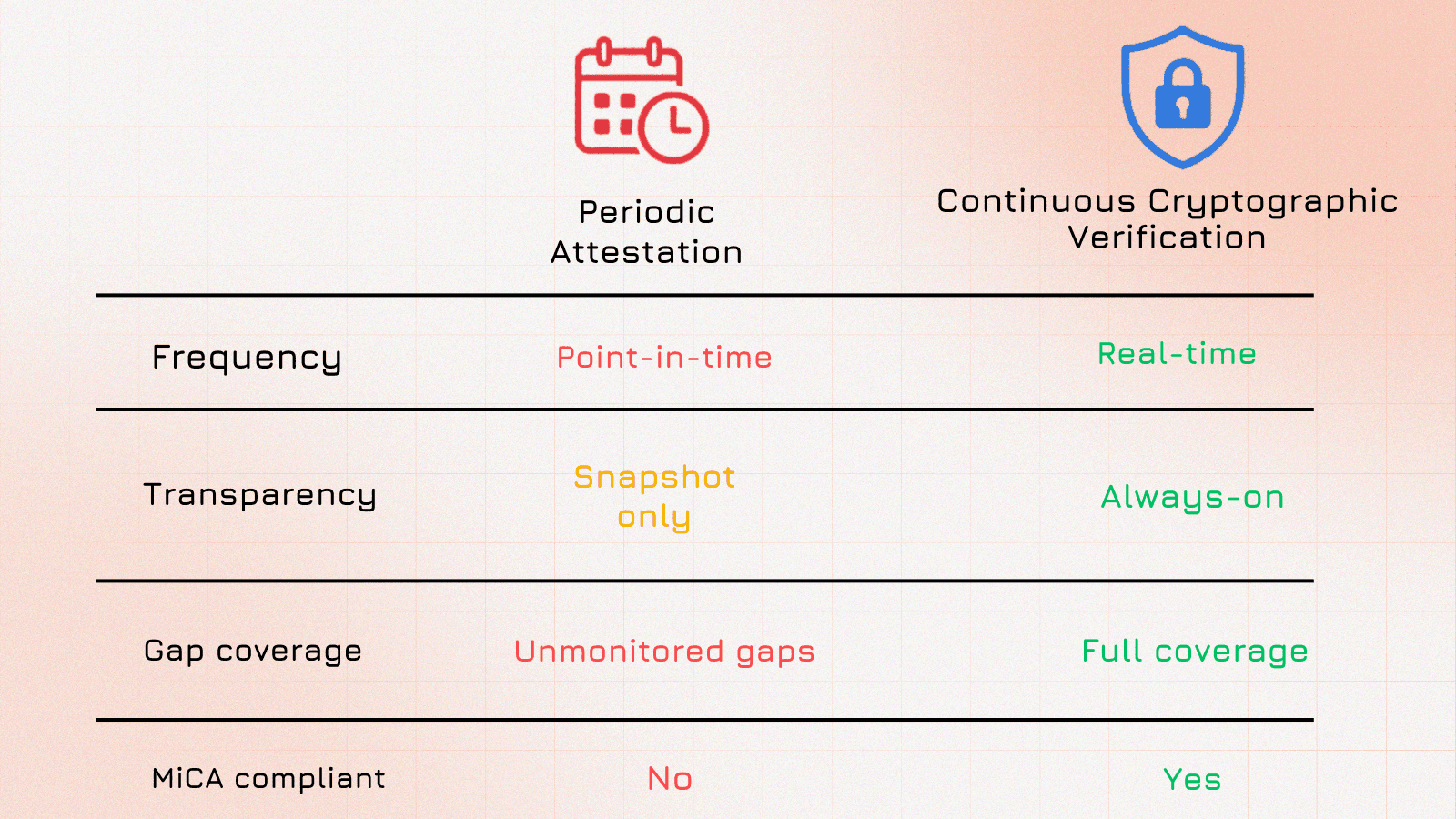 Current attestation models produce point-in-time snapshots. MiCA requires continuous reserve transparency that only cryptographic verification infrastructure can deliver.
How did fragmented national timelines create false confidence?
MiCA enforcement hasn't arrived as a single deadline. It has been a patchwork of national transitional periods that let issuers believe they had more runway than they actually did.
The Netherlands required stablecoin compliance by July 2025. Italy followed in December 2025. Other member states set their own transitional deadlines under MiCA's Article 143(3) framework, creating a landscape where issuers operating across multiple EU jurisdictions faced different compliance walls at different times.
This fragmentation had a specific effect: issuers anchored to the latest deadline rather than the earliest. Teams that weren't required to comply in one jurisdiction assumed the same timeline applied elsewhere. The result is that many issuers are approaching July 2026 with compliance infrastructure designed for a grace-period environment, not a full-enforcement one.
Over 40 stablecoins have already been delisted from EU-regulated exchanges for failing to meet MiCA's reserve and licensing standards. One of the world's largest stablecoin issuers exited the EU market entirely rather than restructure its operations to comply.
The pattern extends beyond Europe. The United States enacted the GENIUS Act (Guiding and Establishing National Innovation for US Stablecoins Act) in July 2025, with final OCC rulemaking due by July 2026. Hong Kong has issued zero stablecoin licenses despite its own regulatory deadline passing. Singapore's stablecoin legislation remains pending, with only two issuers publicly compliant. These aren't separate stories. They're a global convergence toward verification standards that the current attestation model wasn't built to satisfy.
The fragmented rollout gave issuers a false sense of optionality. July 1, 2026 is the hard wall for the EU, and global jurisdictions are converging on similar standards within the same window.
What verification infrastructure would actually satisfy MiCA's standard?
Meeting MiCA's continuous transparency requirement demands infrastructure that generates cryptographic proof of reserve status, not just more frequent reports. The difference is architectural: instead of a human reviewer producing a document at scheduled intervals, a verification system produces machine-verifiable proof every time the reserve state changes.
What are the five infrastructure gaps issuers face?
Five gaps separate current stablecoin operations from MiCA-grade compliance:
Real-time reserve reconciliation is the highest-impact gap. No standardized tooling exists for issuers to continuously reconcile reserve holdings against token supply across multiple custodians and asset types.
Multi-chain token supply integrity is the second gap. Most stablecoins operate across five to fifteen blockchains simultaneously. Tracking total circulating supply across chains is still largely manual.
Audit trail continuity between snapshots is the third. Between audit dates, the chain of custody for reserve data is effectively unmonitored.
Cross-border compliance multiplication is the fourth. MiCA doesn't passport across jurisdictions in the way issuers expected. One issuer now operates four separate legal entities to maintain compliance across the EU, US, Singapore, and Hong Kong.
Qualified auditor capacity is the fifth. The pool of CPA firms qualified to audit stablecoin reserves to MiCA's standard is small, and demand is growing faster than supply.
How do Zero-Knowledge Proofs close these gaps?
Zero-Knowledge Proofs address the core architectural problem: they allow an issuer to prove a statement about reserve composition without revealing the underlying data. A stablecoin issuer can cryptographically prove that reserves exceed liabilities, that assets are held in approved custody arrangements, and that no single reserve component has been reallocated since the last proof, all without publishing a detailed breakdown of which assets are held where.
Orochi Network's zkDatabase provides the Verifiable Data Pipeline that makes this practical. Reserve data enters the pipeline, Zero-Knowledge Proofs are generated at each state change, and the resulting proofs can be verified on-chain by smart contracts, regulators, or counterparties. The proofs are continuous by design, not periodic by schedule. They are machine-readable by default, not converted to machine-readable after the fact. And they preserve commercial confidentiality while satisfying MiCA's transparency mandate.
This is the verification infrastructure layer that sits between an issuer's reserve management system and the regulatory reporting requirement. It doesn't replace auditors; it provides the continuous proof layer that fills the gaps between audit dates. For a deeper look at how this continuous verification infrastructure applies across the broader RWA compliance landscape. You can read more about how Orochi's Verifiable Data Pipeline works end-to-end — from data sampling to cryptographic proof generation — the technical architecture explains why this approach closes gaps that attestation-based models structurally cannot.
The missing layer isn't a better audit firm or more frequent attestation cycle. It's verification infrastructure that produces cryptographic proof: continuous, automated, and regulator-readable.
Conclusion
MiCA stablecoin compliance isn't a future consideration. The July 1, 2026 deadline is 2.5 months away, and the regulatory consequences for non-compliance are severe: fines up to 12.5% of annual turnover, delisting from EU-regulated platforms, and potential license revocation.
The industry's attestation model was built for quarterly reporting in a regulatory environment that now demands continuous proof. Increasing audit frequency doesn't solve the problem because the architecture is point-in-time by design. What MiCA requires, and what the market is converging toward globally, is verification infrastructure that produces cryptographic proof of reserve integrity on an ongoing basis.
Orochi Network's zkDatabase provides this infrastructure. Its Verifiable Data Pipeline turns reserve data into Zero-Knowledge Proofs that regulators, smart contracts, and counterparties can verify at any time, without exposing sensitive reserve composition. For stablecoin issuers evaluating their MiCA readiness, the question isn't whether to upgrade from attestation to verification. It's whether to do it before or after the deadline.
Assess Your MiCA Verification Readiness → Talk to the Orochi team about how zkDatabase maps to MiCA's continuous transparency requirements for stablecoin reserves.
FAQs
What is MiCA stablecoin compliance and when does it take effect?
MiCA stablecoin compliance refers to the reserve transparency, audit, and reporting requirements for E-Money Tokens and Asset-Referenced Tokens under the EU's Markets in Crypto-Assets regulation. Full enforcement begins July 1, 2026, after which all stablecoin issuers must hold authorized licenses, maintain continuous reserve transparency, submit to independent audits every six months, and report in machine-readable formats. Non-compliance carries fines up to 12.5% of annual turnover.
Why don't Proof of Reserve attestations satisfy MiCA requirements?
Proof of Reserve attestations are point-in-time measurements that confirm reserve status at a specific date. MiCA requires continuous transparency, meaning reserve adequacy must be demonstrable on demand, not just at audit dates. Between attestation snapshots, reserves can shift without detection. Multiple stablecoin failures have shown that PoR reports published days before a depeg or fund diversion did not prevent the event because they could not capture real-time changes.
How can Zero-Knowledge Proofs help stablecoin issuers meet MiCA requirements?
Zero-Knowledge Proofs enable stablecoin issuers to generate continuous, cryptographic proof that reserves meet required thresholds without revealing the detailed composition of those reserves. Orochi Network's zkDatabase implements this through a Verifiable Data Pipeline that produces proofs at every reserve state change. These proofs are machine-readable, on-chain verifiable, and privacy-preserving, satisfying MiCA's transparency mandate while maintaining the commercial confidentiality issuers need.
Disclaimer: This article is for informational purposes only and does not constitute legal or financial advice. Consult qualified legal counsel for MiCA compliance guidance specific to your jurisdiction and operations.
Related toStablecoin


