Real - World Assets
Tokenized Treasuries as DeFi Collateral: The Settlement Gap
July 15, 2026
8 mins read
Tokenized treasuries are the largest RWA category and the most common on-chain collateral. But coupon accrual, redemption, and settlement state still live in off-chain systems. When a bond settles in seconds, its lifecycle data has to be verifiable just as fast.


TL;DR: Tokenized treasuries are the most-used real-world asset in DeFi, but their lifecycle data, coupon accrual, NAV, redemption, and settlement finality, still depends on off-chain reporting. When a tokenized bond settles in seconds and is reused as collateral 24/7, point-in-time attestation cannot keep up. zkDatabase makes that lifecycle state verifiable on-chain without exposing the underlying data.
Collateralize a loan, feed a vault, settle a trade, and the same bond is doing all of it at once, its price moving on-chain by the second while its coupon and NAV state sit in systems that update on a slower clock. That split is the real problem with tokenized treasuries as collateral. zkDatabase closes the gap between fast on-chain settlement and slow off-chain lifecycle reporting by making coupon, NAV, and settlement state provable.
Key Takeaways
- Tokenized treasuries reached $13.5B and account for more than half of the active RWA market cap as of March 2026 (DefiLlama State of RWAfi, Q1 2026).
- They are the default collateral in on-chain lending, which means their lifecycle data feeds liquidation and margin decisions directly.
- The gap is settlement and lifecycle: coupon accrual, redemption, and finality still live in off-chain systems that update on a slower cadence than the markets using them.
- Faster on-chain settlement raises the stakes: when a bond changes hands in seconds, stale lifecycle data becomes an instant exposure.
- zkDatabase proves coupon, NAV, and settlement state on-chain, so a protocol verifies the bond's condition instead of trusting a delayed report.
Why are tokenized treasuries the most-used DeFi collateral?
Tokenized treasuries are the most-used DeFi collateral because they pair familiar, low-volatility yield with the credit quality institutions already underwrite. As of March 2026, tokenized funds, dominated by treasury products, reached $13.5B and represent more than half of the active RWA market cap, according to DefiLlama. That scale makes them the natural reserve asset for on-chain lending and structured strategies.
Their popularity is also what makes their data load-bearing. When a tokenized bond is posted as collateral, its reported value drives loan-to-value, margin, and liquidation logic. The asset is trusted precisely because it is a government bond, but the on-chain protocol does not see the bond. It sees a token and a feed.
That distinction is the whole problem. The credit quality is real; the on-chain visibility into the bond's current state is not guaranteed.
What lifecycle data does a tokenized bond carry off-chain?
A tokenized bond carries coupon accrual, valuation, redemption, and settlement state, and most of it is computed and reported off-chain. Each of these is a moving value, and each feeds an on-chain decision when the bond is used as collateral. A snapshot taken at the wrong moment misprices the position.
| Lifecycle event | What changes | On-chain consequence if stale |
|---|---|---|
| Coupon accrual | Daily interest builds into value | Collateral undervalued or overvalued |
| NAV / mark | Price moves with rates | Wrong loan-to-value, mistimed liquidation |
| Redemption / maturity | Principal returns, token retires | Collateral that no longer exists is still counted |
| Settlement / finality | Ownership transfers | Position priced on a trade not yet final |
Today a protocol relies on an oracle feed plus the issuer's reporting for these events. That works until the cadence breaks: the bond's off-chain books update on a business-day rhythm while the lending market runs continuously, the same NAV cadence gap that already affects tokenized funds, now extended across the bond's full lifecycle.
Why does faster settlement make the verification gap worse?
Faster settlement makes the gap worse because it shortens the window in which collateral state must be correct, while the lifecycle data feeding that state still updates slowly. As tokenized bond settlement moves toward near-instant, the asset can be transferred, repledged, and liquidated in the time it used to take a single confirmation. The data has to be right at that speed, not at end-of-day.
Near-instant settlement is one of tokenization's strongest claims, and capital-markets regulators from MAS Project Guardian to the UK FCA's fund-tokenization rules have flagged settlement finality as a core design question. The benefit is real. But it only holds if the bond's lifecycle state can be verified as fast as it settles. Otherwise the protocol is just settling faster on data it still cannot independently confirm.
This is where tokenized bonds stop being a pricing problem and become a settlement-integrity problem. The same tokenized-securities data verification gap that appears once settlement infrastructure like the DTCC's moves securities on-chain.
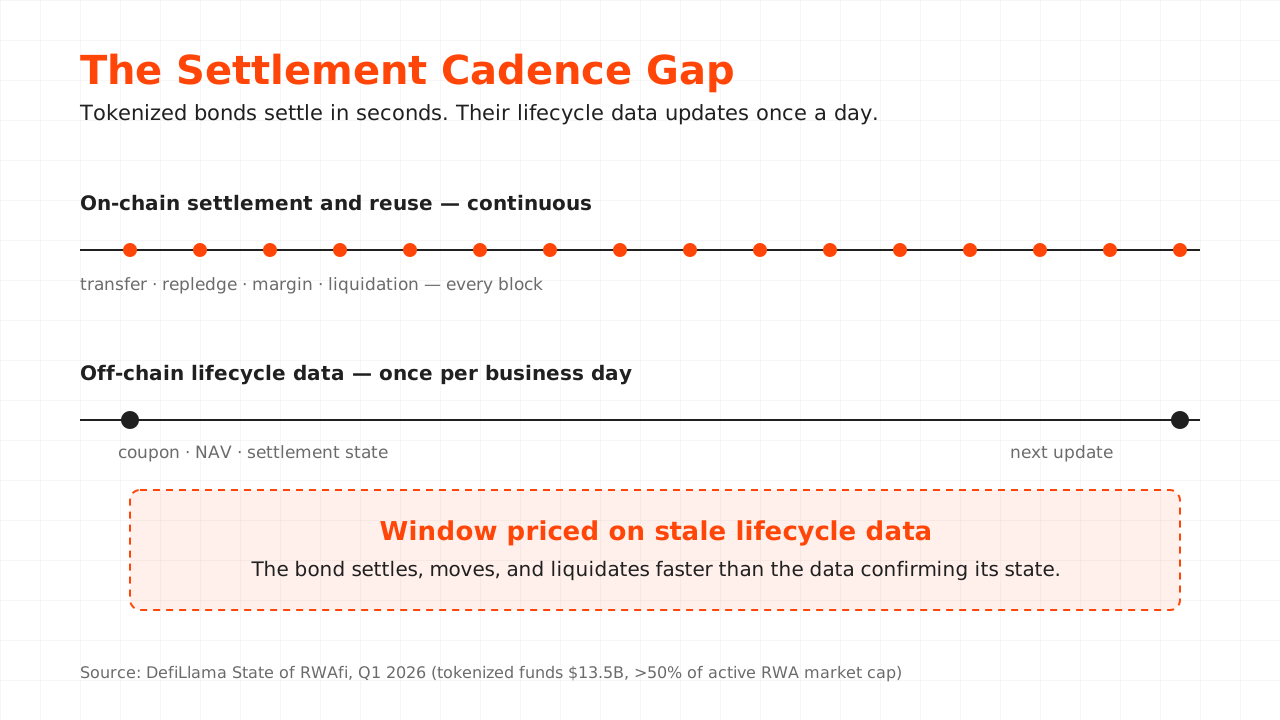 A tokenized bond can settle and be repledged in seconds, while its coupon and valuation data still updates on a business-day cadence, leaving a window priced on stale state.
Bottom line: Speed without verifiable lifecycle data does not reduce risk. It compresses the same trust gap into a smaller window where mistakes are harder to catch.
How does verifiable data close the settlement gap?
Verifiable data closes the gap by attaching cryptographic proof to the bond's lifecycle state, so a protocol verifies coupon, valuation, and settlement directly instead of trusting a report. Instead of consuming a published mark, the lending market checks a proof that the underlying data, custodian data, accrual calculation, settlement confirmation, satisfies the stated condition.
For a tokenized treasury used as collateral, that means proving the current accrued value and that the position has settled, without exposing the issuer's full books. The protocol gets evidence at settlement speed; the sensitive data stay private. zkDatabase generates these Zero-Knowledge Proofs across the data pipeline, from ingestion to on-chain verification.
zkDatabase does not replace the custodian or the issuer's reporting. It gives every downstream protocol a reserve state it can verify without trusting whoever produced it, which is what lets fast settlement and safe collateral use coexist.
How does zkDatabase fit tokenized bond infrastructure?
zkDatabase sits between a tokenized bond's off-chain lifecycle systems and the on-chain markets that price it, turning reported coupon, NAV, and settlement state into Verifiable Data. It targets the moment a lending market or curator has to act on the bond's current condition.
- Pain: protocols liquidate and margin against coupon and settlement data they cannot independently confirm.
- Mechanism: zkDatabase produces Zero-Knowledge Proofs over the bond's lifecycle data pipeline.
- Outcome: contracts verify accrued value, redemption status, and settlement finality continuously, without exposing the data.
For capital-markets teams, this is the layer that makes tokenized fund and bond data integrity hold up under institutional underwriting.
Conclusion
Tokenized treasuries are the largest RWA category and the most-used DeFi collateral, which means their lifecycle data, coupon, NAV, redemption, settlement, sits directly under on-chain margin and liquidation decisions. Faster settlement does not remove the verification gap; it compresses it. The asset is only as safe as the data a protocol can confirm at the speed it settles. Verifiable Data Infrastructure is how that confirmation keeps pace. zkDatabase is built to prove a tokenized bond's lifecycle state on-chain, so settlement speed and collateral safety stop working against each other.
Explore zkDatabase
See how a Verifiable Data Pipeline proves a tokenized bond's coupon, NAV, and settlement state on-chain.
FAQ
What makes tokenized treasuries useful as DeFi collateral?
Tokenized treasuries are useful as DeFi collateral because they offer low-volatility yield backed by government credit quality institutions already understand. As of March 2026, they make up more than half of the active RWA market cap, which makes them the default reserve asset in on-chain lending. The trade-off is that their value drives margin and liquidation logic, so their lifecycle data has to be reliable.
What is the settlement gap for tokenized bonds?
The settlement gap is the mismatch between how fast a tokenized bond settles and trades on-chain and how slowly its lifecycle data, coupon accrual, NAV, redemption, and finality, updates off-chain. When a bond can be transferred and liquidated in seconds but its underlying state reports on a business-day cadence, a protocol can price or liquidate the position on stale data.
Does faster settlement reduce risk for tokenized treasuries?
Not on its own. Faster settlement compresses the window in which collateral state must be correct, but it does not make the underlying lifecycle data more verifiable. Without proof of coupon, valuation, and settlement finality at settlement speed, near-instant settlement just moves the same trust gap into a smaller, harder-to-catch window. Verifiable data is what turns speed into lower risk.
How does zkDatabase verify tokenized bond lifecycle data?
zkDatabase generates Zero-Knowledge Proofs over a tokenized bond's off-chain lifecycle data, so a protocol can verify accrued coupon value, current NAV, redemption status, and settlement finality on-chain without seeing the issuer's full data. This converts reported lifecycle state into Verifiable Data, giving lending markets evidence at the speed the bond settles instead of a delayed report.
Related toReal - World Assets